The essentials in 40 seconds

WeJustice · Legal tech · since 2025

Rebuilding Palace.legal into a SaaS platform for collective actions, from mockup to code.

Since 2020, Palace.legal has carried the legal ultimatums of lawyer Arnaud Durand: over 300,000 signatories across five actions, from the vaccine contracts to the Linky ultimatum. Demand was proven; the tool no longer kept up. I am a partner and rebuilt the product end to end: journeys, architecture, screens, code, automations and SEO. The complete platform runs as a public demo, with launch in preparation at wejustice.fr.

Explore the live demo The demo is public and free to explore, no sign-up needed.

The problem

Palace.legal proved the demand: 287,717 signatories for transparency on the vaccine contracts, 66,376 against 5G, 15,562 against the Linky meter. But the site, built for petitions, could not operate a service: no member area, no case tracking, no online payment, and manual management behind every action.

My role

Partner, in charge of product and service design, since 2025. The lawyer owns the legal side and the professional ethics. I own the whole product: the journeys, a deliberately light Figma mockup, then the front-end code, payment, automations and SEO, with AI as a production tool.

What I did

  • Mapped the whole service: sitemap of the public site, member area and admin, architecture of front end, API and data.
  • Built the journeys end to end: one-click signing, member onboarding, claimant file, plans and payment reminders.
  • Coded the complete front end in Next.js on the Django API: CMS, CRM, KPI dashboards, 33 automated emails, multilingual SEO.

The result

  • The complete platform runs as a public demo: actions, member area, plans, payment.
  • The historical actions and their 300,000 signatories carry over into the new product.
  • A service that can be operated day to day: admin, CRM, dashboards and 14 scheduled automations.

How I got there

The method in detail, for those who want to dig deeper. You can also stop at the essentials above.

01

The starting point: Palace.legal and its 300,000 signatories

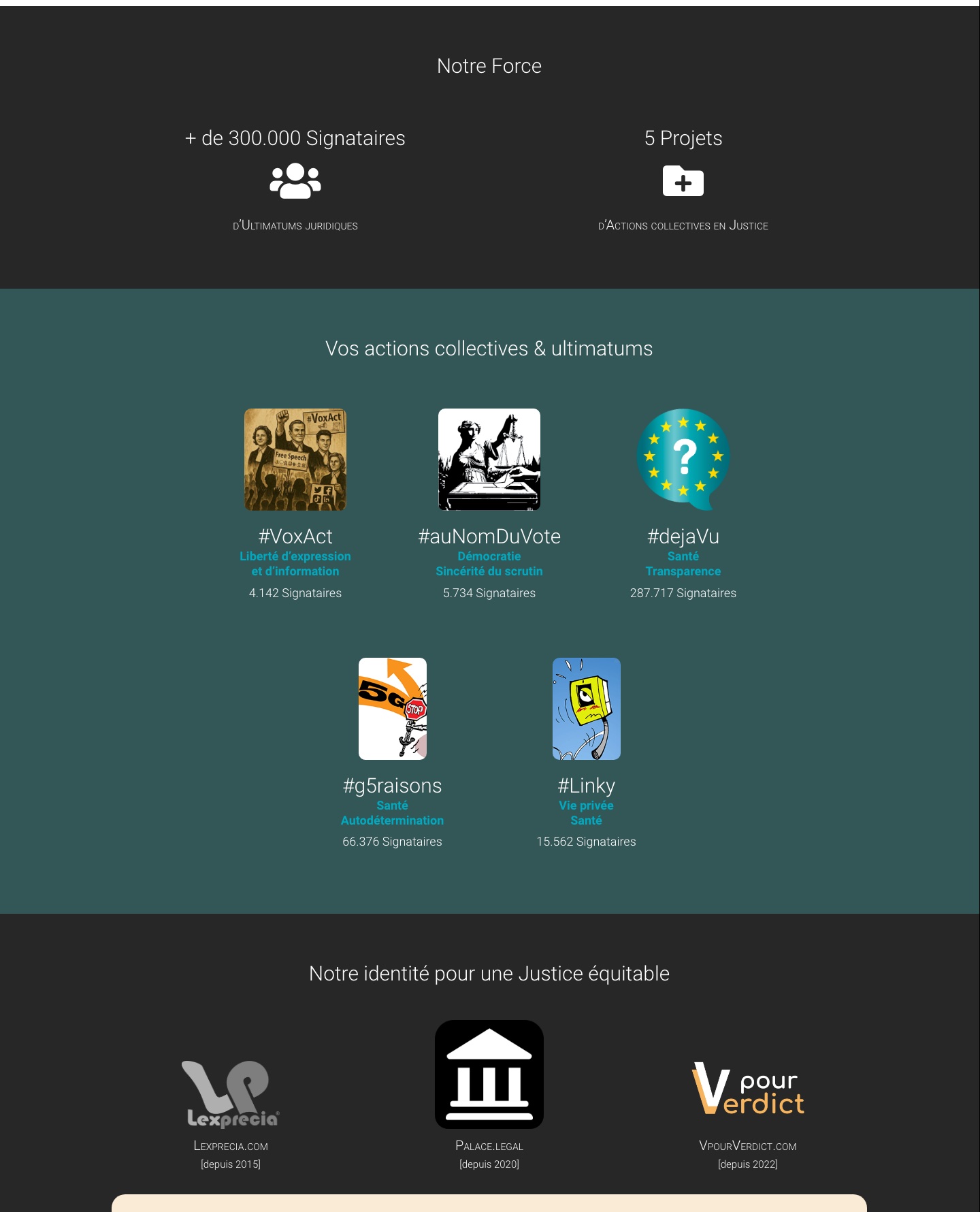
Lexprecia since 2015, Palace.legal since 2020, VpourVerdict since 2022: lawyer Arnaud Durand's ecosystem has long carried legal ultimatums. Five collective actions gathered over 300,000 signatories there, and battles were won, from the removal of Linky meters ordered by the Tours court to the reinstatement of a nurse.

The site fulfilled its mobilisation mission. Everything else, membership, files, payment, follow-up, remained manual. We decided to turn it into a platform.
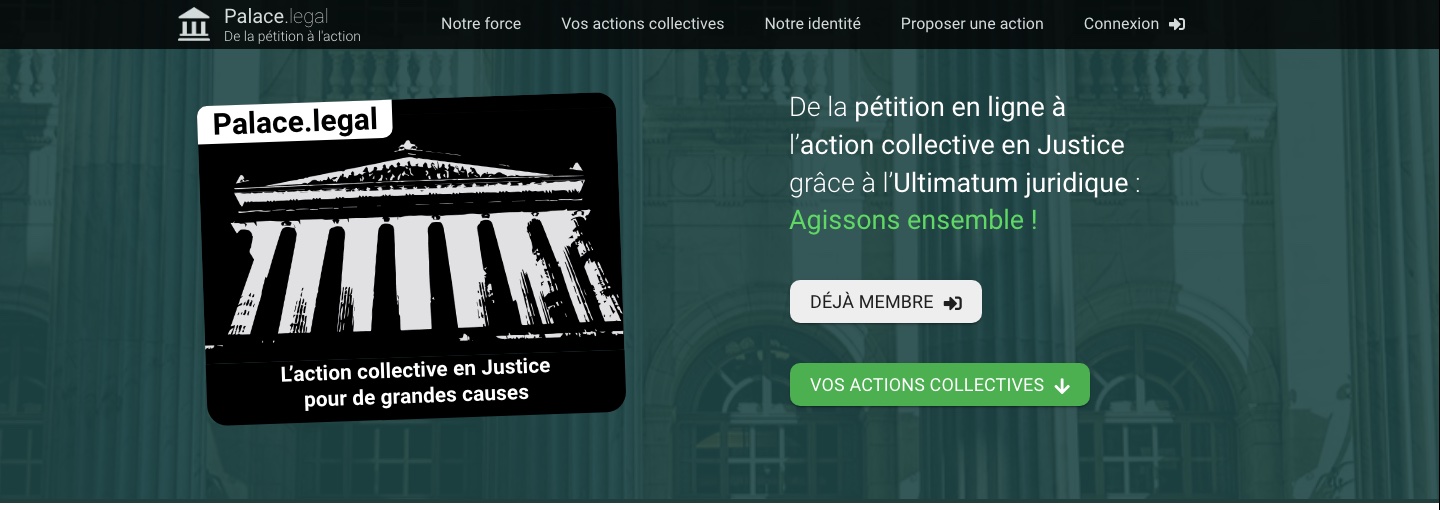
The existing site, as still online today: the traction was there, the product remained to be built.
02

Mapping before designing: sitemap and architecture

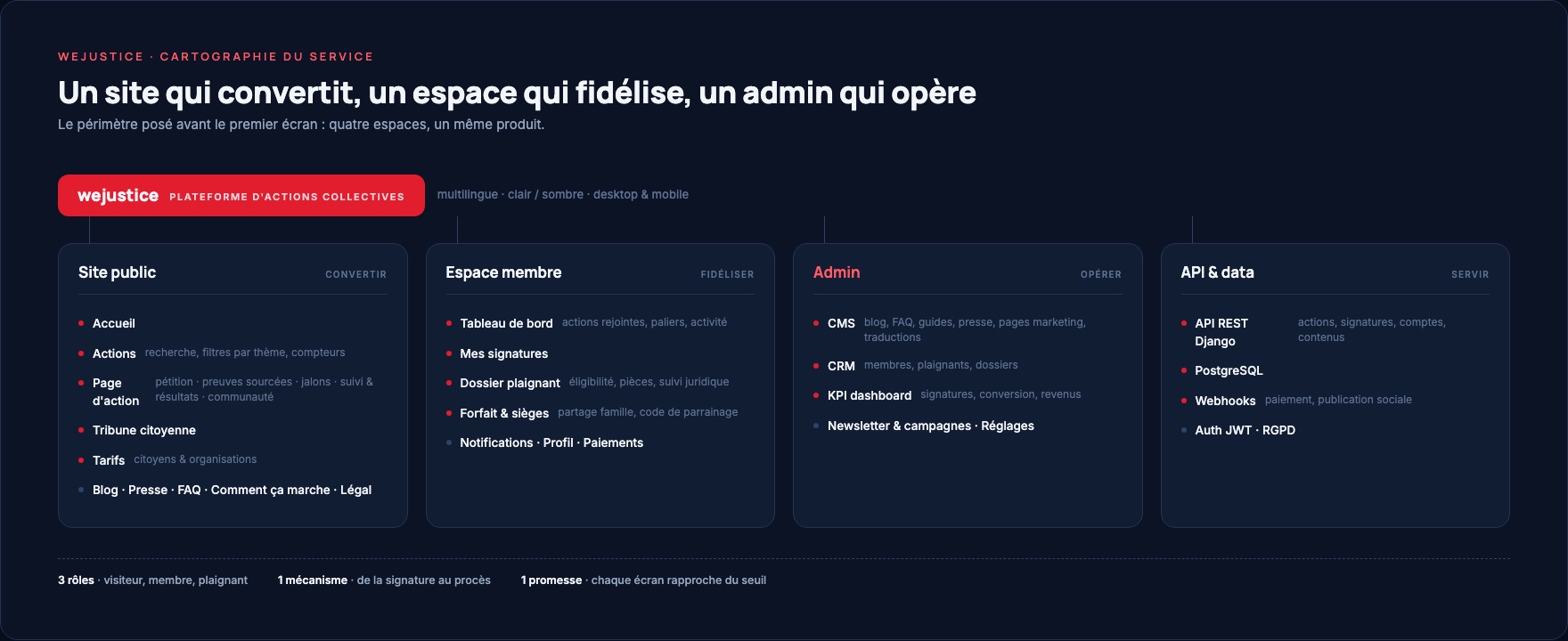
Before the first screen, I laid out the map. The sitemap splits the product into four spaces: a public site that converts a visit into a signature, a member area that retains and manages the file, an admin that operates the service, and the API serving it all.

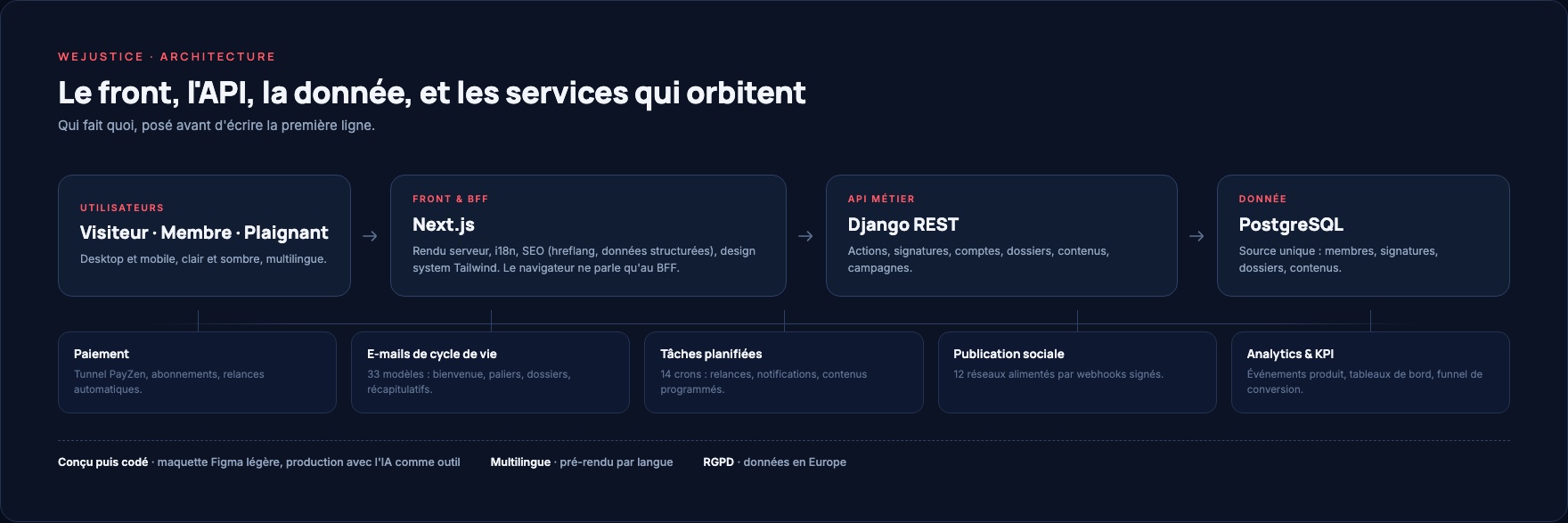
The architecture sets who does what: the Next.js front end renders the pages and carries SEO, the Django API holds the business logic, PostgreSQL keeps the data, and the orbiting services handle payment, emails, scheduled tasks, social publishing and KPIs.

WeJustice sitemap: public site, member area, admin and API, with their main pages.
The sitemap: four spaces, one product.
Architecture diagram: users, Next.js front end, Django REST API, PostgreSQL, and five satellite services (payment, emails, crons, social networks, analytics).
The architecture: the front end, the API, the data and the orbiting services.
03

A light mockup, then the product built in code

The Figma mockup stayed deliberately light: the journeys, the templates, the charter. The real work happened in code, with AI as a production tool: I built the complete front end in Next.js on the Django API, multilingual and pre-rendered page by page.

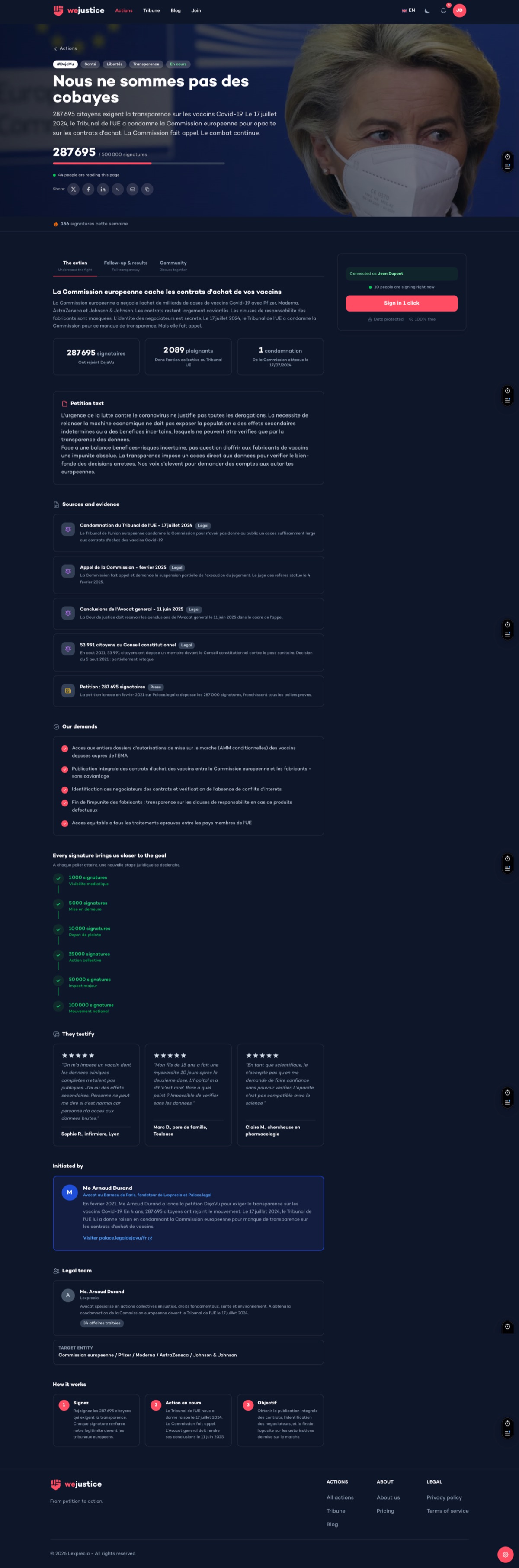
The action page concentrates the mechanism: the counter and its goal, the petition text, the sourced evidence (EU General Court, Constitutional Council), the milestones that trigger each legal step, and one-click signing.

wejustice-demo.vercel.app
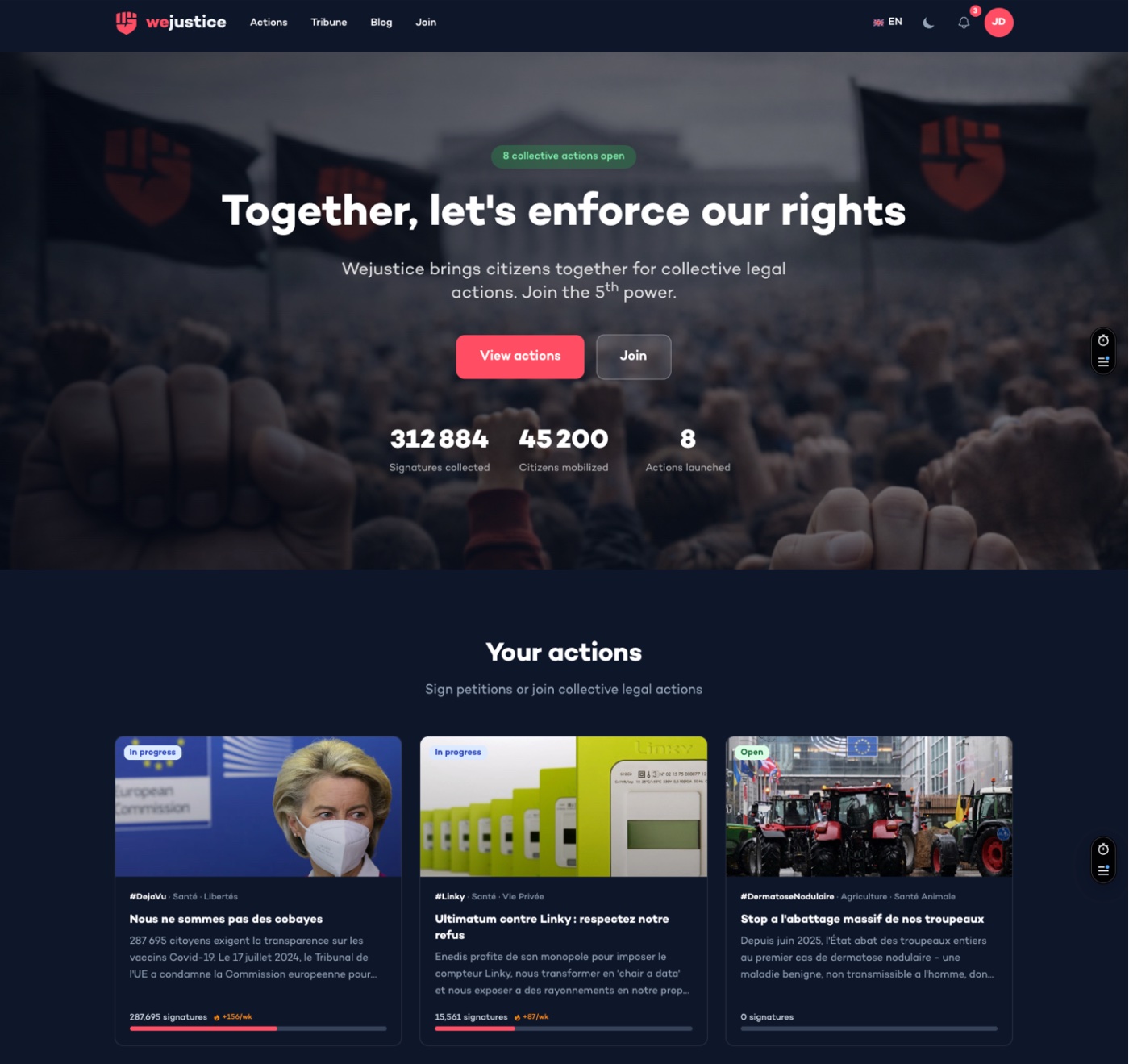
The WeJustice home in dark mode: hero over a crowd photo, mobilisation counters and first actions.
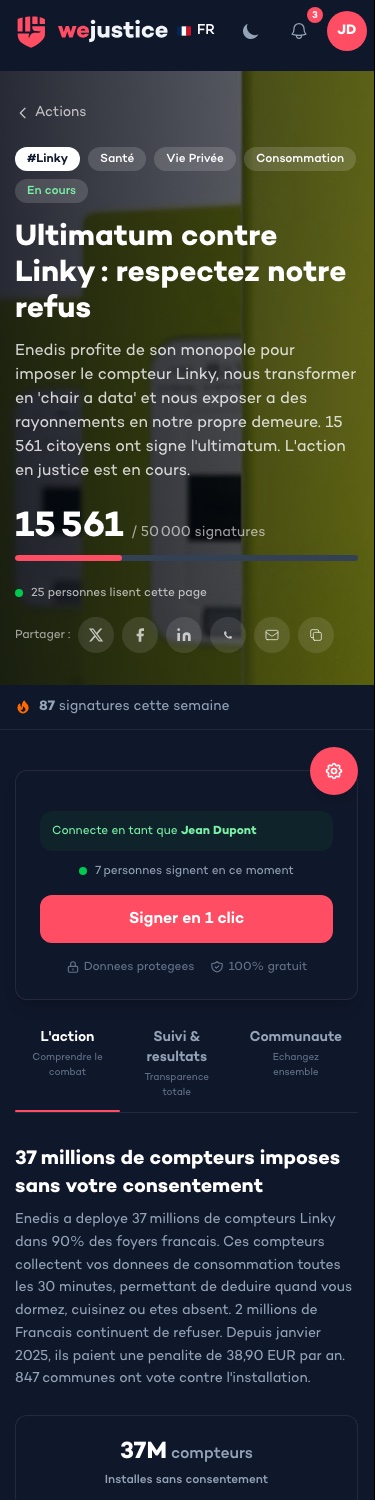
The action page on mobile: signature counter, signing form.
The product live, on desktop and mobile. Captures from the public demo.
wejustice-demo.vercel.app
The full page of the 'We are not guinea pigs' action: signature counter, petition text, sourced evidence, legal milestones and testimonials.
The full action page scrolls inside the frame: counter, petition, evidence, milestones, testimonials. Hover to pause.
04

The UX choices: trust before conversion

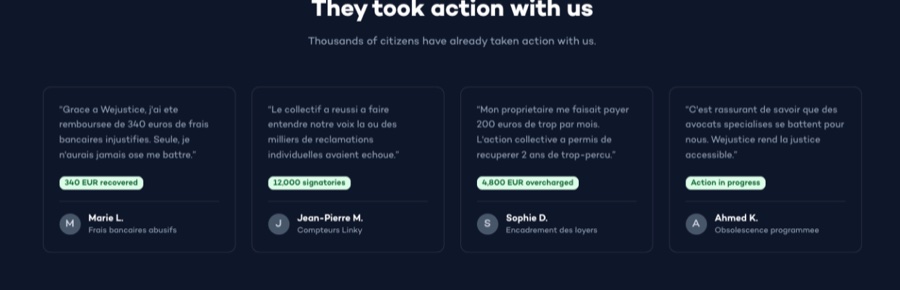
A legal service is not allowed to promise an outcome. The design owns that constraint instead of disguising it: the hero announces "transparency, GDPR, no promise of result", and everything displayed is a verifiable fact: signatures collected, each action's velocity, testimonials stated as concrete outcomes (€340 recovered, €4,800 of overcharged rent refunded).

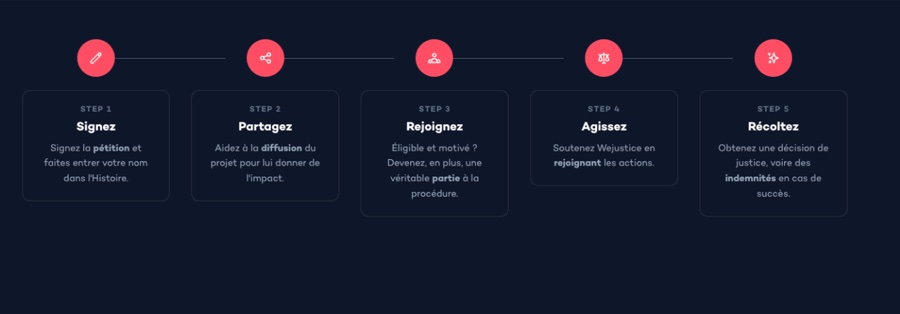
The journey is told in five steps, from signature to compensation, and commitment rises in tiers: signing is free and immediate, joining unlocks follow-up and party-to-the-procedure status, collecting comes with success. Dark mode is native, on a par with light.

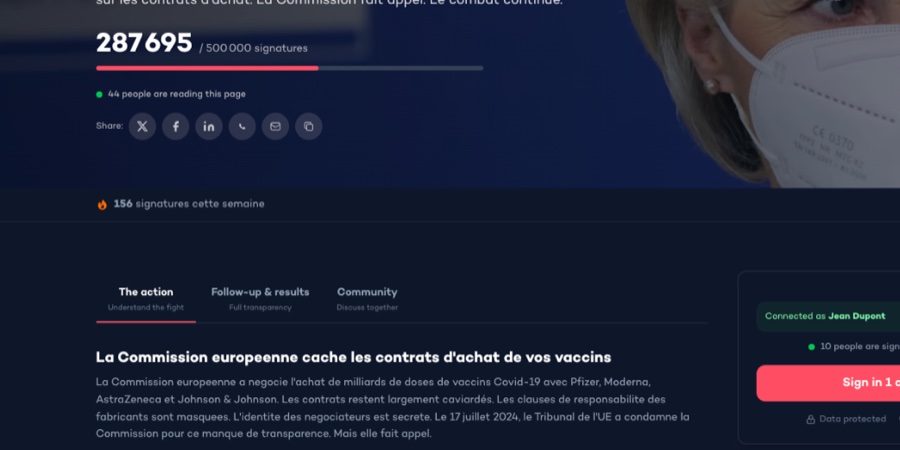
The action counter: 287,695 signatures, weekly velocity and the goal.
The counter, proof before promise287,695 verifiable signatures, this week's velocity, the goal to reach.
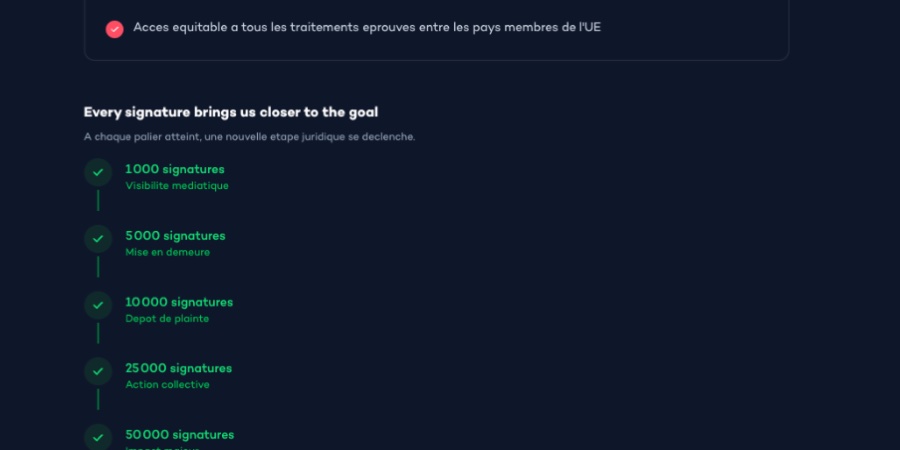
The action's milestone list: each signature threshold triggers a legal step.
The milestones that trigger the legal stepsEach signature threshold unlocks a step of the procedure.
The five-step journey: sign, share, join, act, collect.
The five-step journeySign, share, join, act, collect.
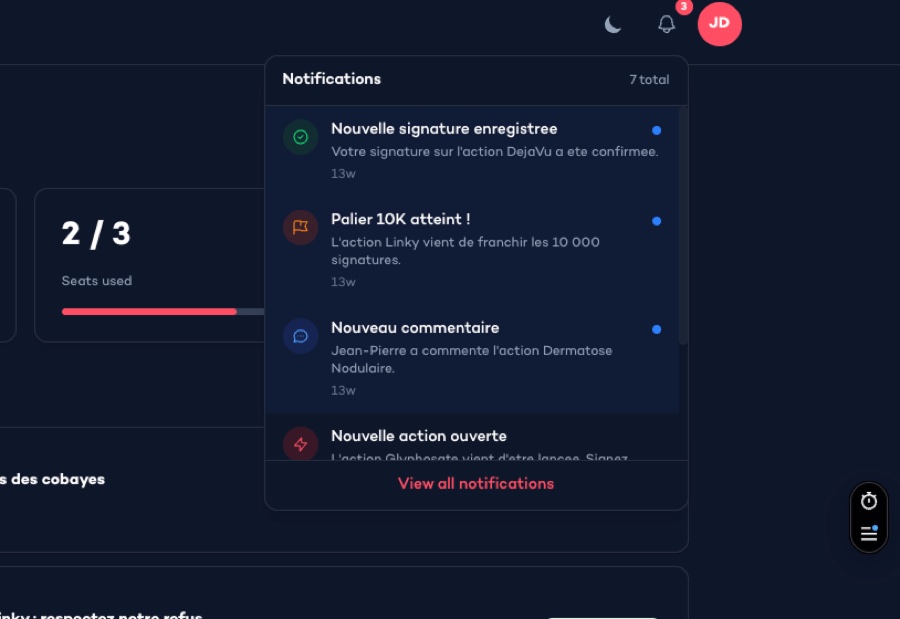
The member account's notification panel: signature confirmed, threshold reached, new comment.
Member follow-upSignature confirmed, threshold reached, new comment.
Four testimonials with their quantified outcome, including €4,800 of overpayments refunded.
Testimonials as concrete outcomesEach testimonial shows a quantified outcome and the action that produced it.
Five design choices, five interface moments. Captures from the public demo.
05

The public site: converting a visit into a signature

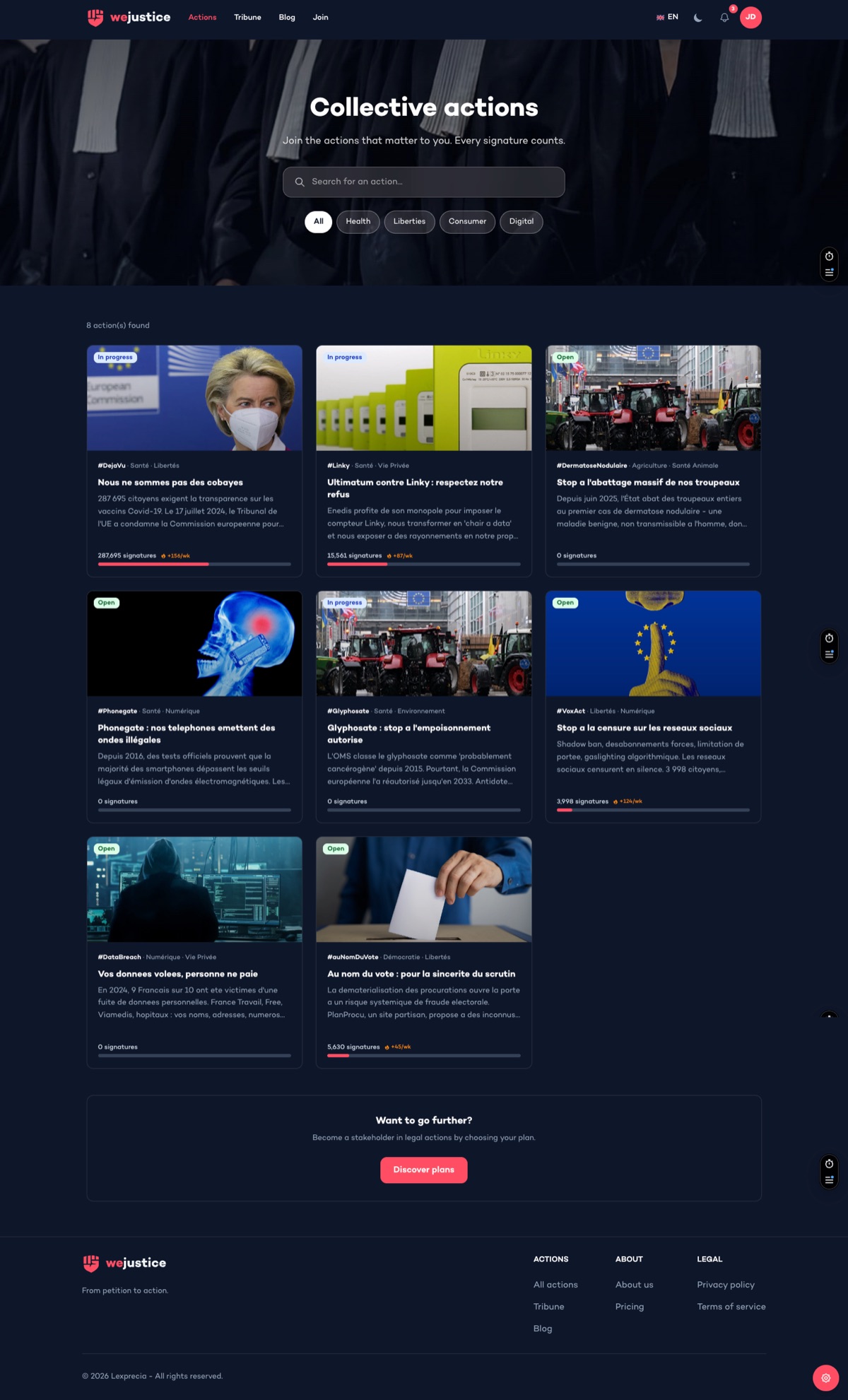
Search, theme filters, action cards with counters and signature velocity, multi-channel sharing: every screen pushes towards the signature, on desktop and mobile alike. Content, blog, FAQ, press, marketing pages, lives in the CMS and serves acquisition.

wejustice-demo.vercel.app
The actions list: search, theme filters and a grid of photo cards with signature counters.
The actions list scrolls inside the frame: search, theme filters, counters and velocity. Hover to pause.
06

The member area and the business model

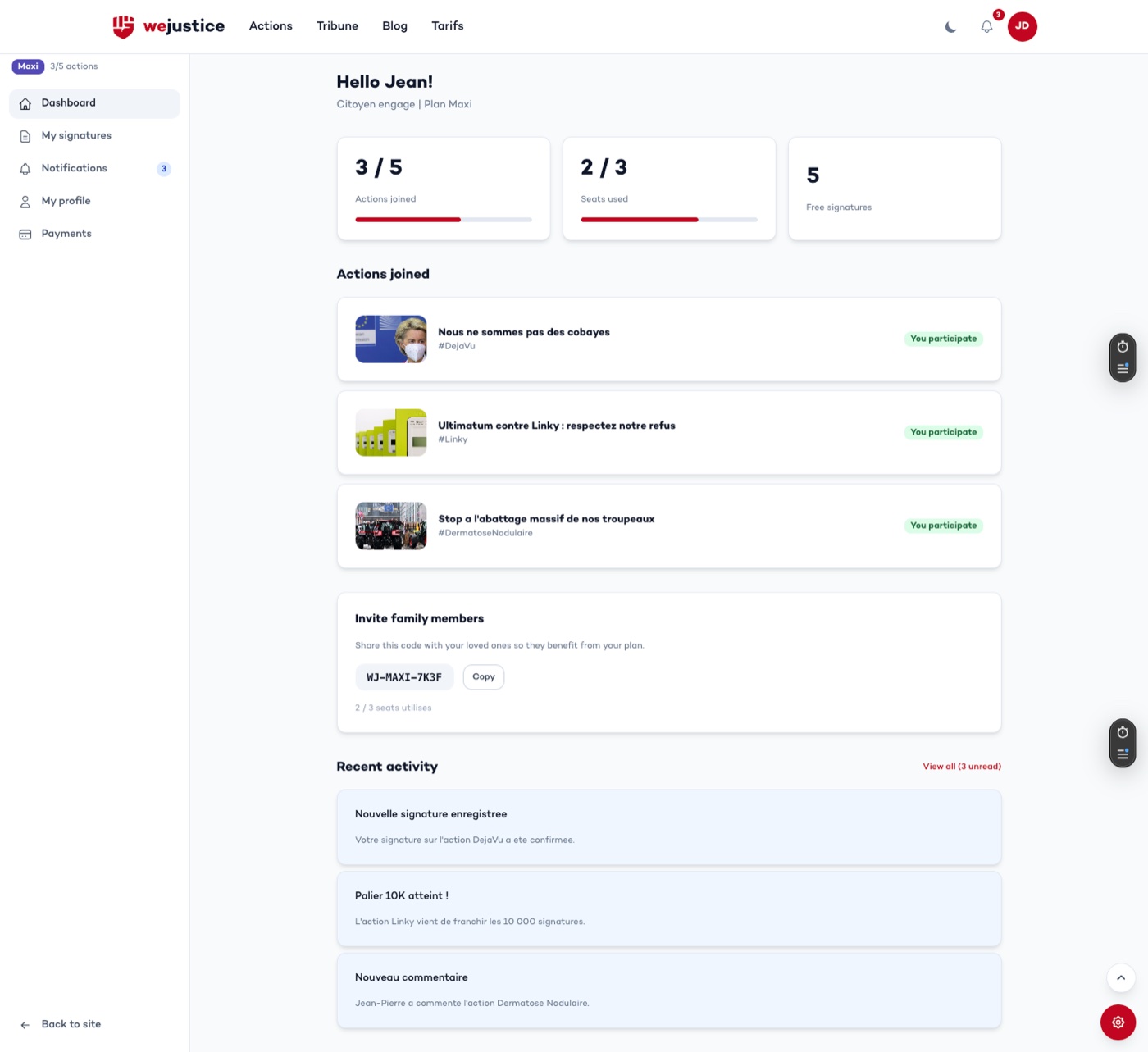
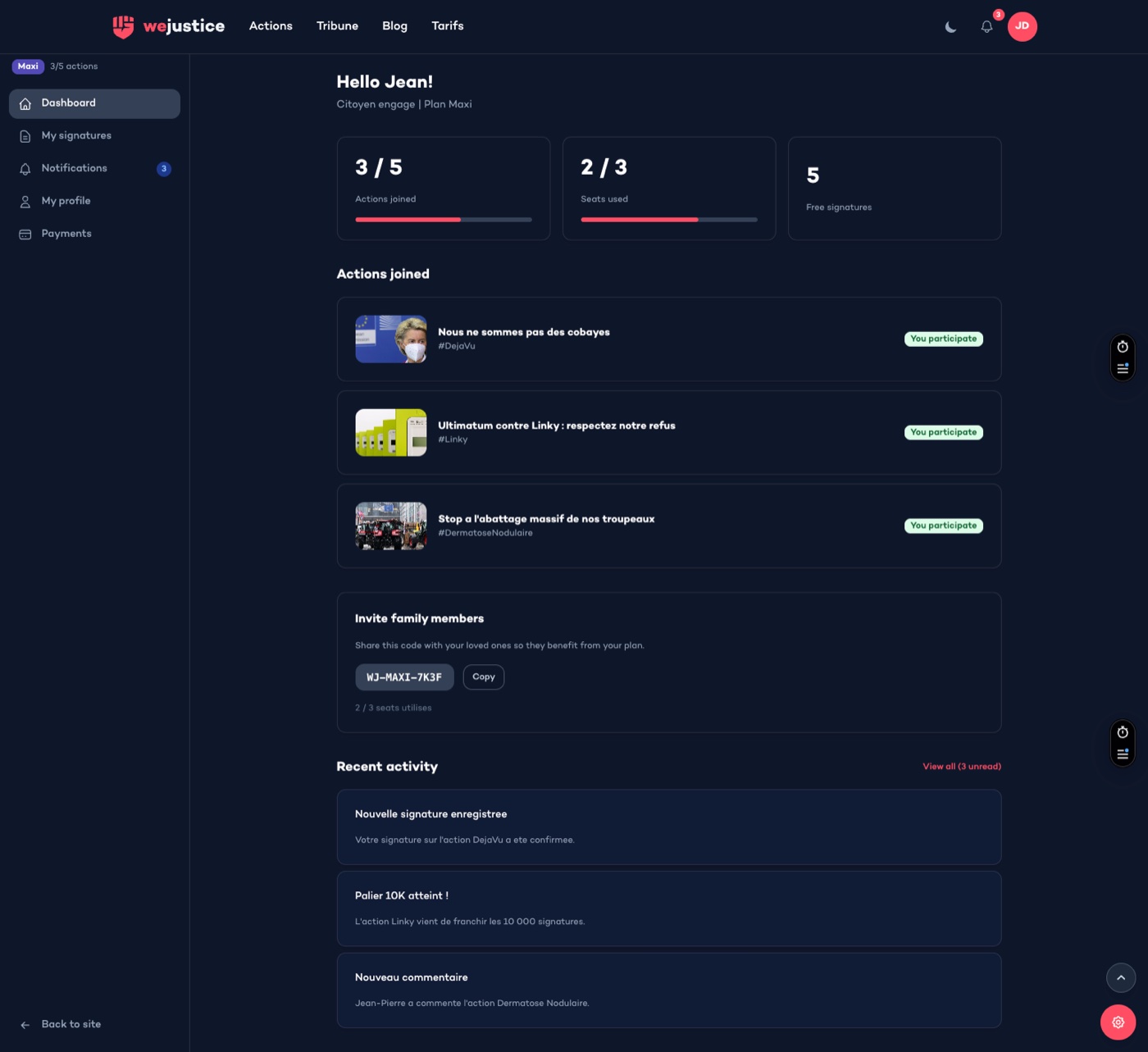
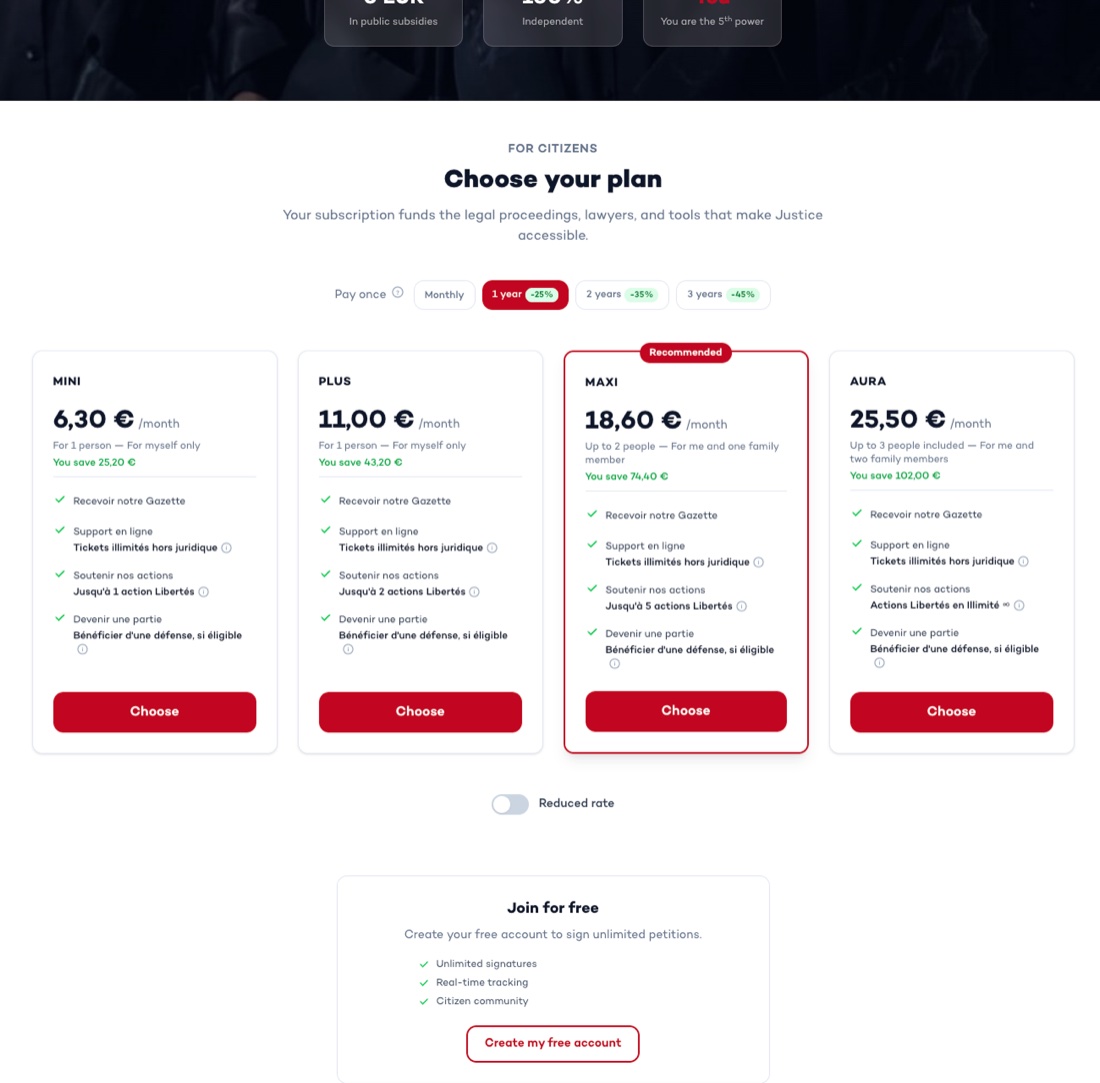
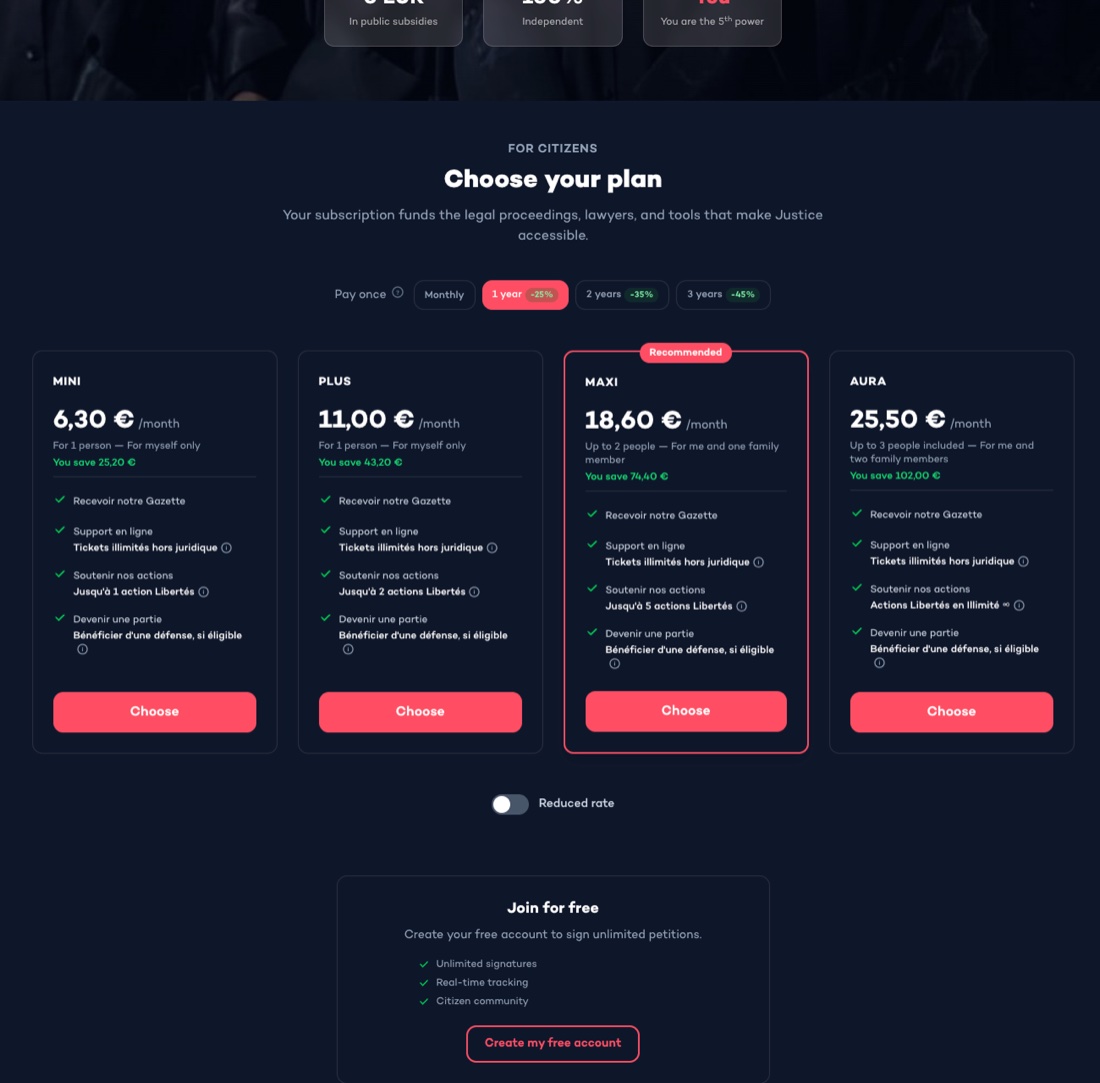
The member account automates what used to be manual: onboarding, tracking joined actions, milestone notifications, building the claimant file, payments and reminders. The plans, from Mini to Aura, fund the procedures, with shareable seats and a built-in referral code.

Behind the scenes, the admin covers the CMS, the CRM of members and claimants, and the KPI dashboards: signatures, conversion, revenue.

The member area and pricing, captured on the public demo.
07

Automations, SEO and going live

Fourteen scheduled tasks keep the service running without intervention: 33 lifecycle emails, payment reminders, notifications, newsletters, scheduled content and automated publishing to twelve social networks. SEO is handled in depth: pages pre-rendered per language, structured data, sitemaps.

The complete demo is public, and the launch is being prepared at wejustice.fr: the historical actions, from the Linky ultimatum to the vaccine contracts, find their signatories there again.

A similar challenge on your side?

Thirty minutes on the phone to talk it through, with no commitment.

hello@christophevanengelen.com