Barclays SmartBusiness
Signature · app marketplace
- Very appealing visual design
- Integrates with small-business management software
- App Marketplace model

 2018 — 2019
Transactional data was sleeping on the servers. At the exit, SME merchants were willing to pay for access, before the first line of code.
BNP processed 30% of the country's Bancontact payments. No service was extracting value from this data for the merchants who accepted them.
The tensionFour internal functions to align on a single scope · Banking, IT, Legal, Marketing.
What I didSix months upstream. Stakeholder Map, Customer Journey, Value Proposition Canvas. Six merchants interviewed at their workplace, including Léonidas.
What came out of itConcept Report signed. Léonidas pre-signed a firm purchase commitment before development. Four functions aligned, P1/P2 backlog ready for sprints.
An unmatched view of Belgian consumer purchasing behaviour, accumulated on the Bancontact network. On the merchant side · 1500 retailers listed in ATOS, 901 registered on Easy Banking Business, 234 active, only 15% regular. No service was turning that data into value for those accepting the payments.
BNP was aiming for 2020 to become Acquirer in its own right · lifting POS marketshare from 7% to 20%, and opening acquiring to large retailers via Corporate Banking by Q2 2018. The service to design wasn't a data gadget, it was the spearhead of a positioning strategy.
My mandate held in four verbs · frame, test, align, defend. Confront the opportunity with the field, get Banking, IT, Legal and Marketing in the same room, carry the recommendation up to the steering committee.
6 months · 4 internal functions · 6 SMEs on the ground · freelance Service Designer
Strategyzer · Lean Canvas + Value Proposition Canvas, the native methodology of the CXC department. Toolkit calibrated to validate a mature B2B revenue hypothesis. Léonidas signed before the first line of code.
From opportunity to market signal. A four-act methodological journey, from Design Thinking through to a prototype tested under real conditions.
Exit deliverable · MVP prioritised in user stories, signed off by Banking · IT · Legal · Marketing.
From Liberal Pro to Corporate Banking SME. Map built on the interviews + the Levels of Interest matrix (Ideation Report, Oct 2017) · key target retained for the concept · B2C multi-shops without internal data support.
Lawyer, doctor, senior self-employed. Wants to steer, not to explore.
One activity, one view. Looks for immediate clarity.
Small shop. Knows customers by heart, sceptical about data.
The KEY TARGET. Several outlets, little internal data support.
Under a brand. Receives central reports but wants his own ground.
Local marketing. Wants to test actions and measure their impact.
Runs the shop day to day. Traffic, basket, loyalty.
Corporate profile. Would expect advanced profiling: language, profession, income.
Bank for Entrepreneurs. MVP target for whom BNP has the most useful data.
Ninety minutes each, behind the counter, watching what gets decided in a day.
"I see my sales, but not who makes them."
Léonidas — future signer of the purchase commitment. Seven points of sale. Pricing calls made blind.
"I know my best customers. Not my best days."
Single boutique, central Brussels. No POS, manual register. Basket evolution by instinct.
"My accountant gives me the figures too late."
Restaurant 35 covers. Monthly reporting lagging 6 weeks. Misses seasonal waves.
"No time for Excel. Give me 3 numbers."
Medical practice 2 practitioners. No back-office team. Maximum demand: 3 KPIs readable in 30 seconds.
"My franchisor sends me HIS figures. Not mine."
Three shops under two brands. Wants to compare his points of sale to each other and to the sector benchmark.
"We have an internal BI. But for finance. Not for the floor."
BFE smaller corporate, 40 employees. Tools exist but unfit for the operational floor manager.
Three players studied, three distinct signatures · each isolated on its angle of strength.
Signature · app marketplace
Signature · geolocation flows
Signature · anonymous data API
Three families of data on merchants · Bancontact transactions, consumer card profiles, bank accounts. Raw, they're worthless. Cross-referenced, they produce six actionable readings, each tied to a persona type.
Three overlapping circles Customers, Area, Sector — their overlaps produce six actionable insights.
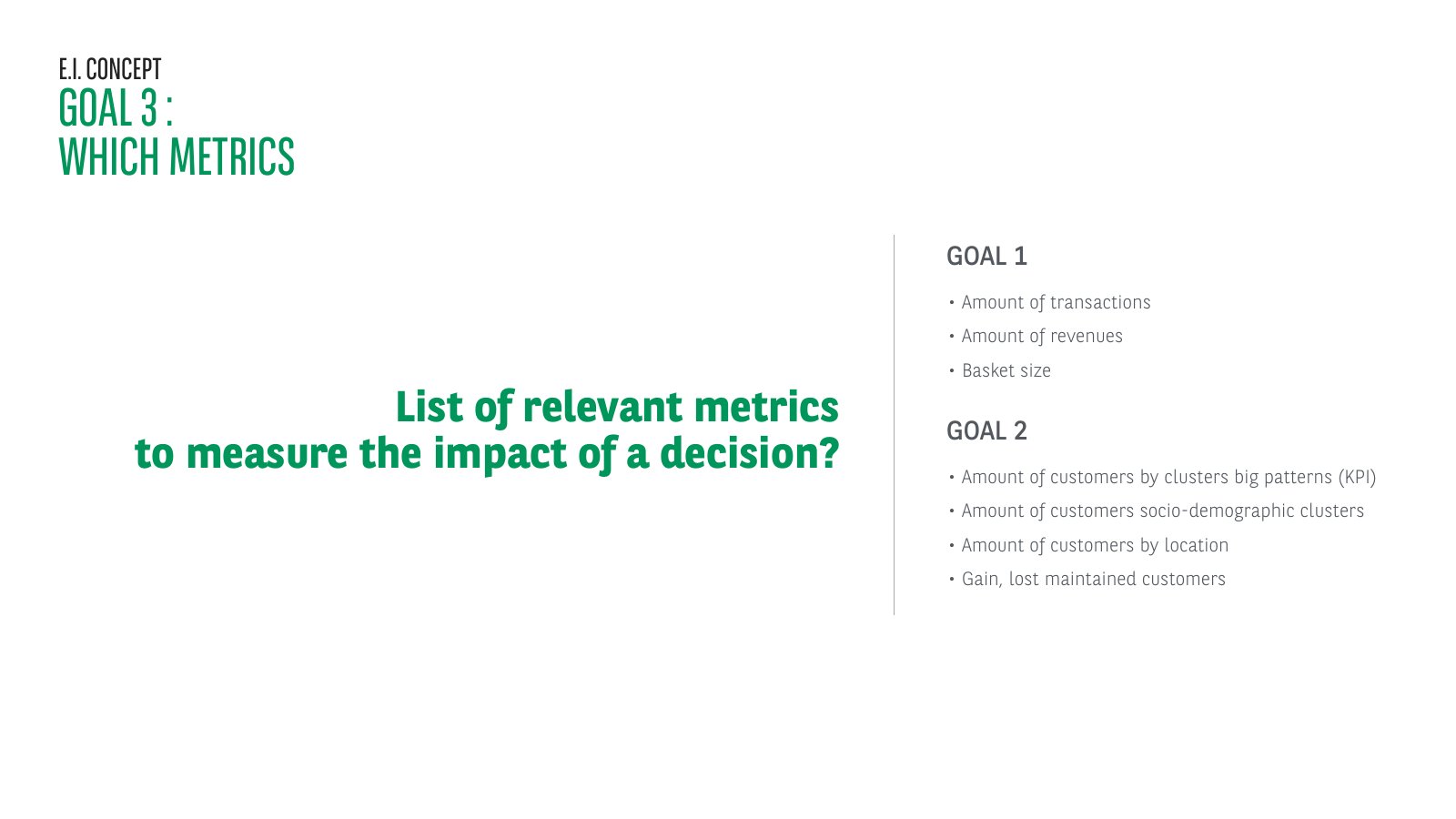
The Value Proposition Canvas pits the merchant's jobs (knowing customers better, calibrating actions) against the BNP offer. Every MVP feature must tick at least one Pain Reliever or Gain Creator. Otherwise, out of scope.
Left · classic dashboard pushing data. Right · goal-oriented report producing actionable insights.
The user has an objective, we deliver an objective-oriented report. Period.
Not an exploratory platform. A tool-equipped narrative.
Source · Concept Report March 2018 · slide "E.I. Concept · Value Proposition"
The merchant opens the app with a specific goal, not with a desire to explore.
Why is Enterprise Intelligence relevant to my business?
What insights will I actually gain from it?
How do I use it, this morning at 8am, behind my counter?
He wants information as fast as possible, with no effort. He won't explore more data than he can process.
Every merchant need maps to one deliverable of the future product. Not one more.
| Need | What the product delivers |
|---|---|
| Goals report | Goal-oriented report aligned with business objectives |
| KPI overview | KPIs focused where the decision happens |
| Information | Text that explains the dataviz, not the other way round |
| Outcomes | Ready-to-use outcomes to avoid mental calculation |
| Personalisation | Aggregation customised to the merchant's products |
Banking, IT, Legal and Marketing share the same sentence, the same user, the same 5 deliverables. Common ground.
Next step → Ideation · Develop · 4 Goals identified in workshop Ideation · 4 Goals identifiés en atelierMarketing carried an initial data-exploration POC. Rejected by pilot clients and the SteerCo. The VP refocused · one read, one decision.
First POC carried by Marketing · contextual filters + 5 demographic dimensions. Tested with pilot clients, rejected by the SteerCo. The merchant had to build their own reading.
Post-VP refocus · four KPIs on four business goals. Red · decide now. Orange · watchpoint. Green · what works. One read, one decision.
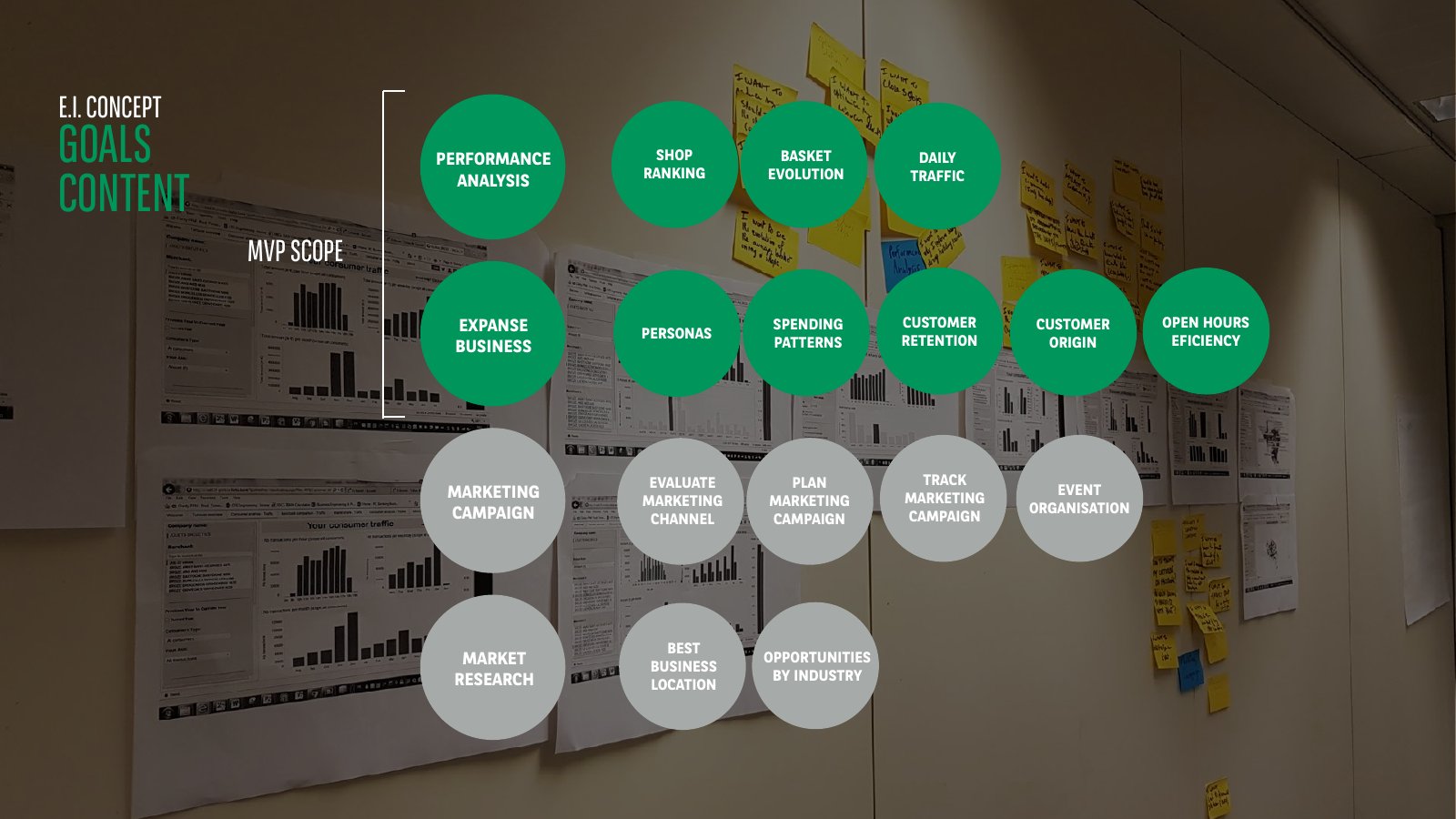
Eighteen candidate features on the wall. Ten retained for MVP (green), eight out of MVP (grey). Consolidated into three reports + one in phase 2.
"Where do I open the next shop?"
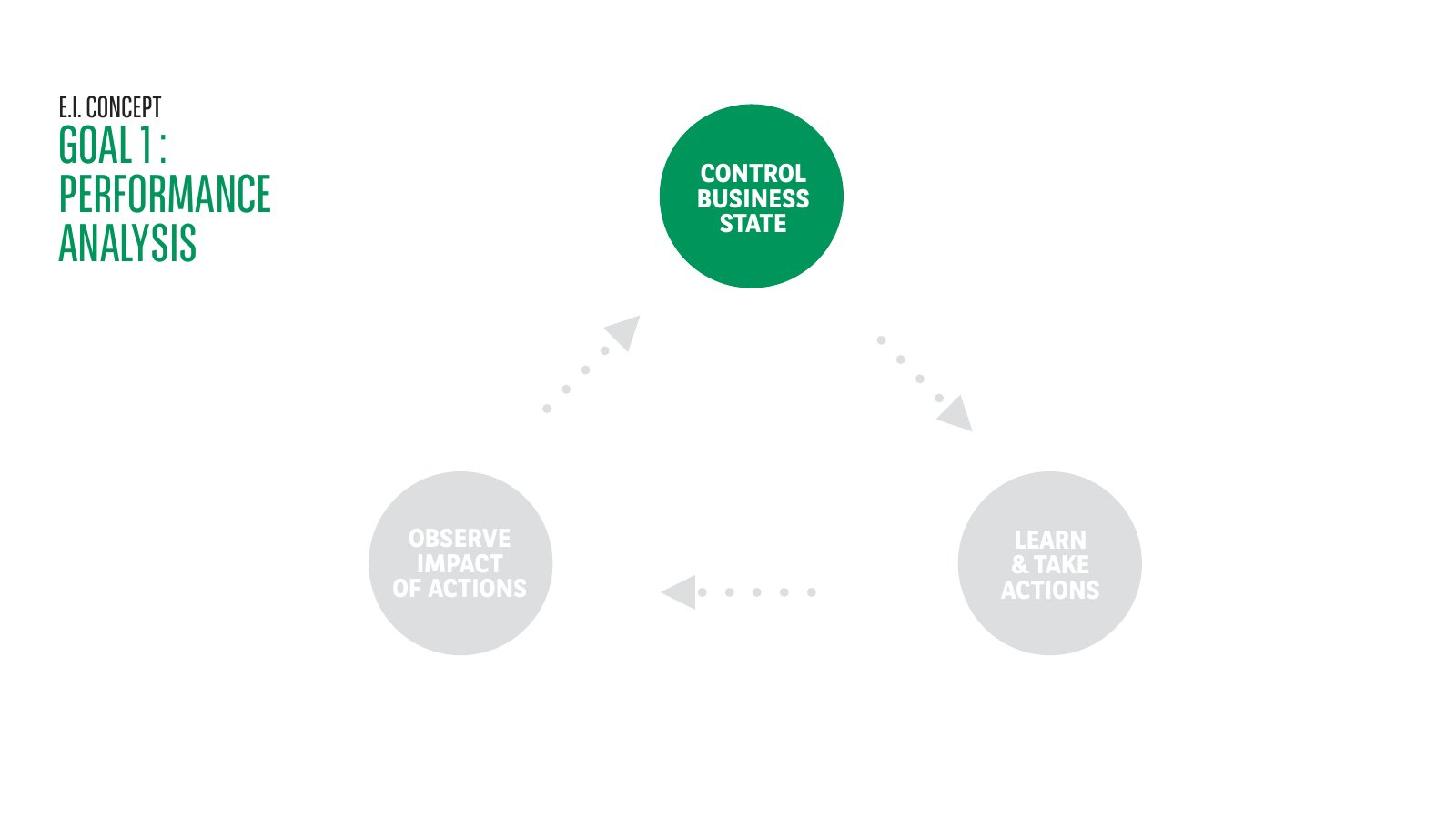
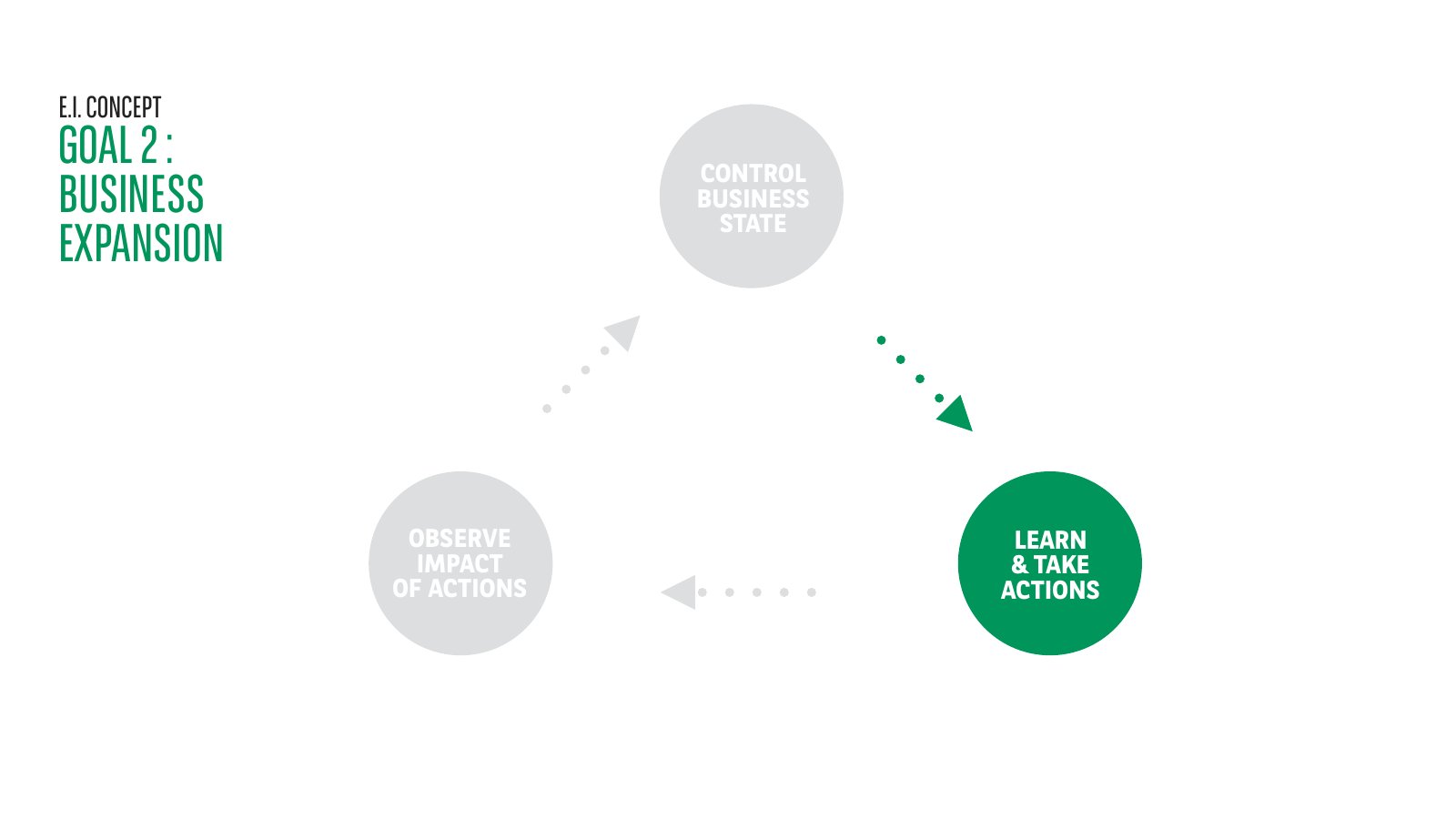
Three reports, one decision loop. Day's question · action · measurement.
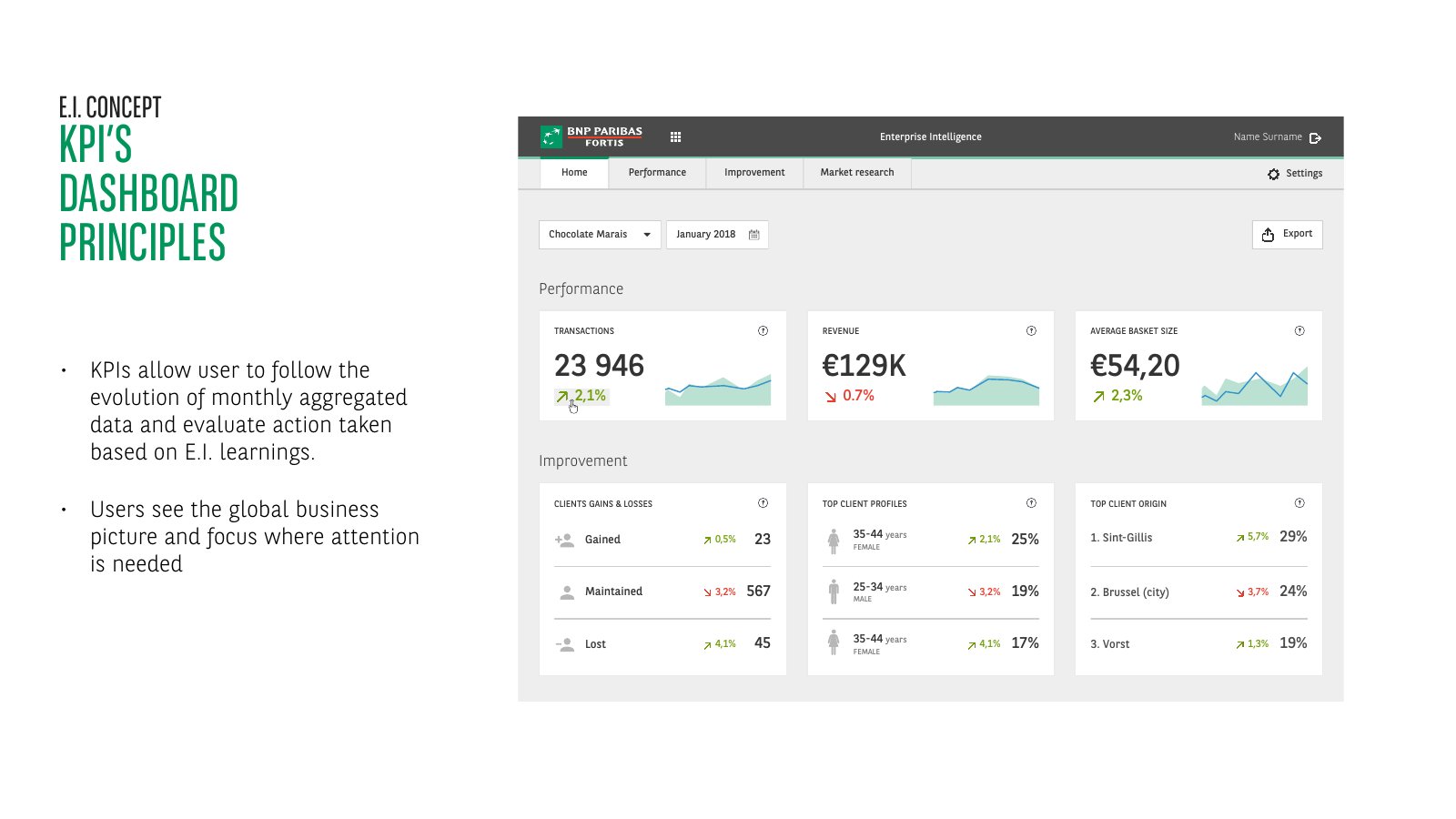
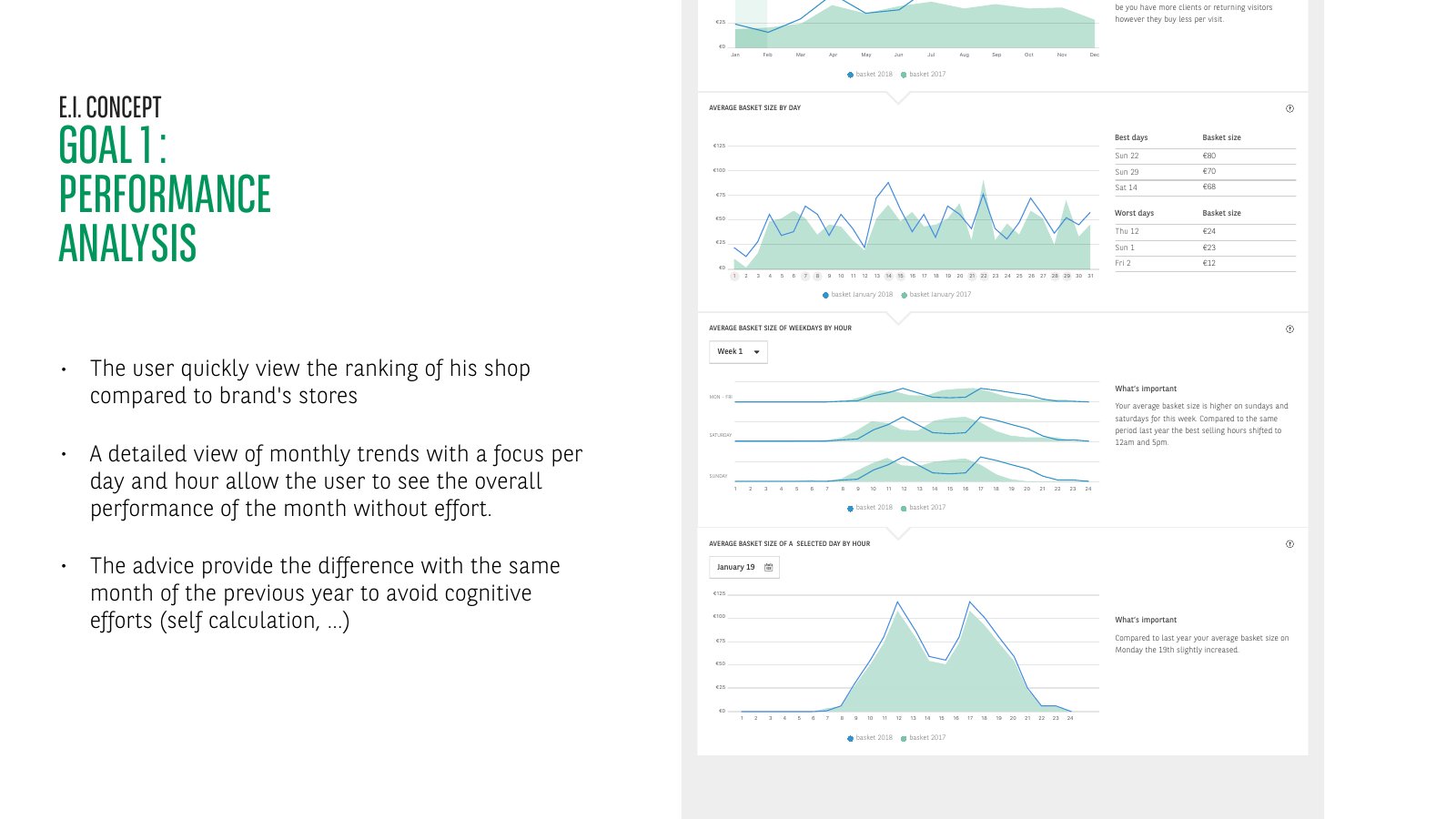
Not a report · a panorama. Three performance KPIs on top, three improvement indicators below. In five seconds the merchant sees what works, what slips. Each detailed report opens from here.
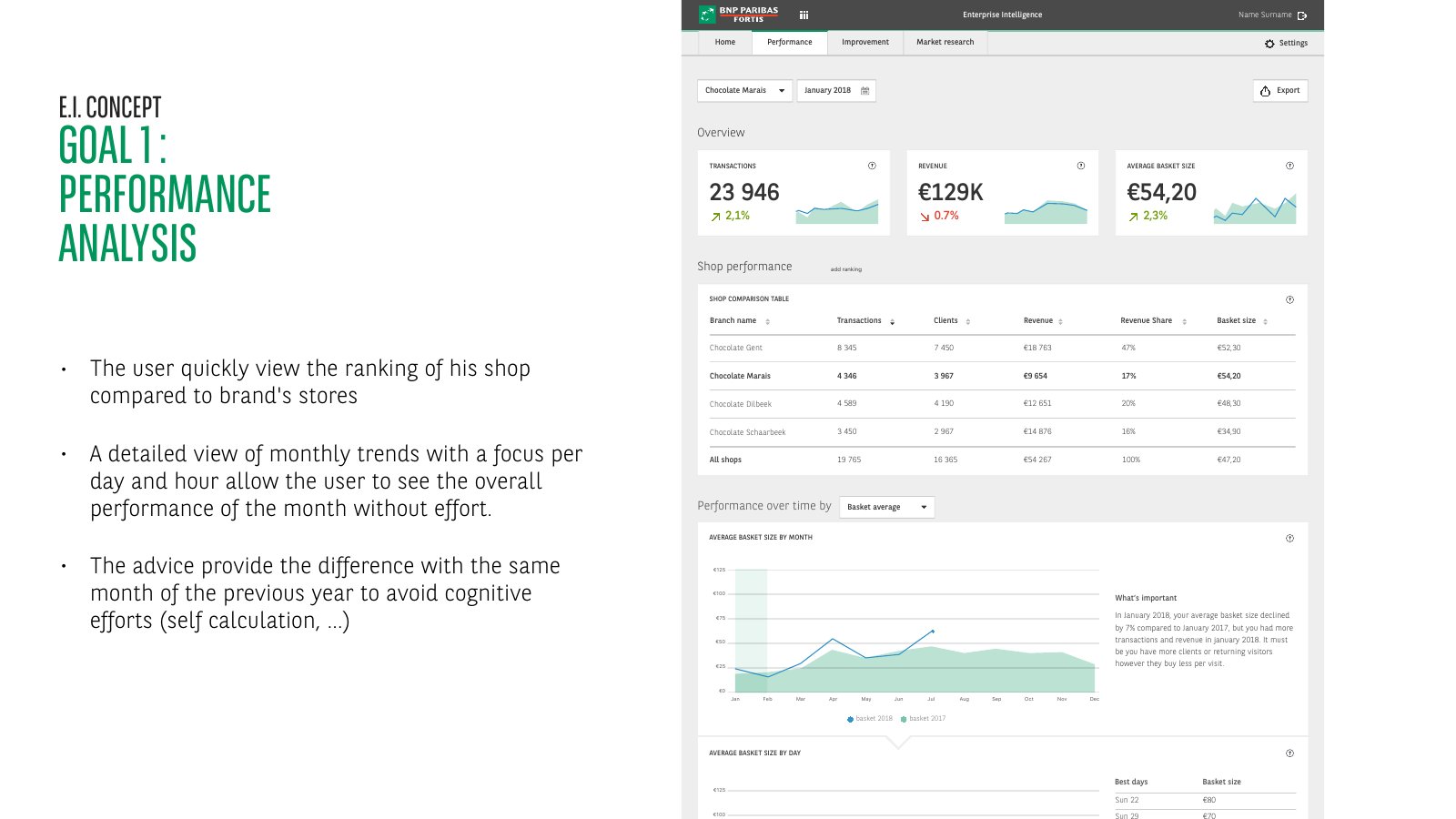
Five seconds for the monthly read · three KPIs, his shop compared to the network, the gap vs N-1 highlighted. No filters, no chart to build. The data speaks, he decides.
The promise : 5 seconds for what an analyst would do in 30 minutes. No data skill required.
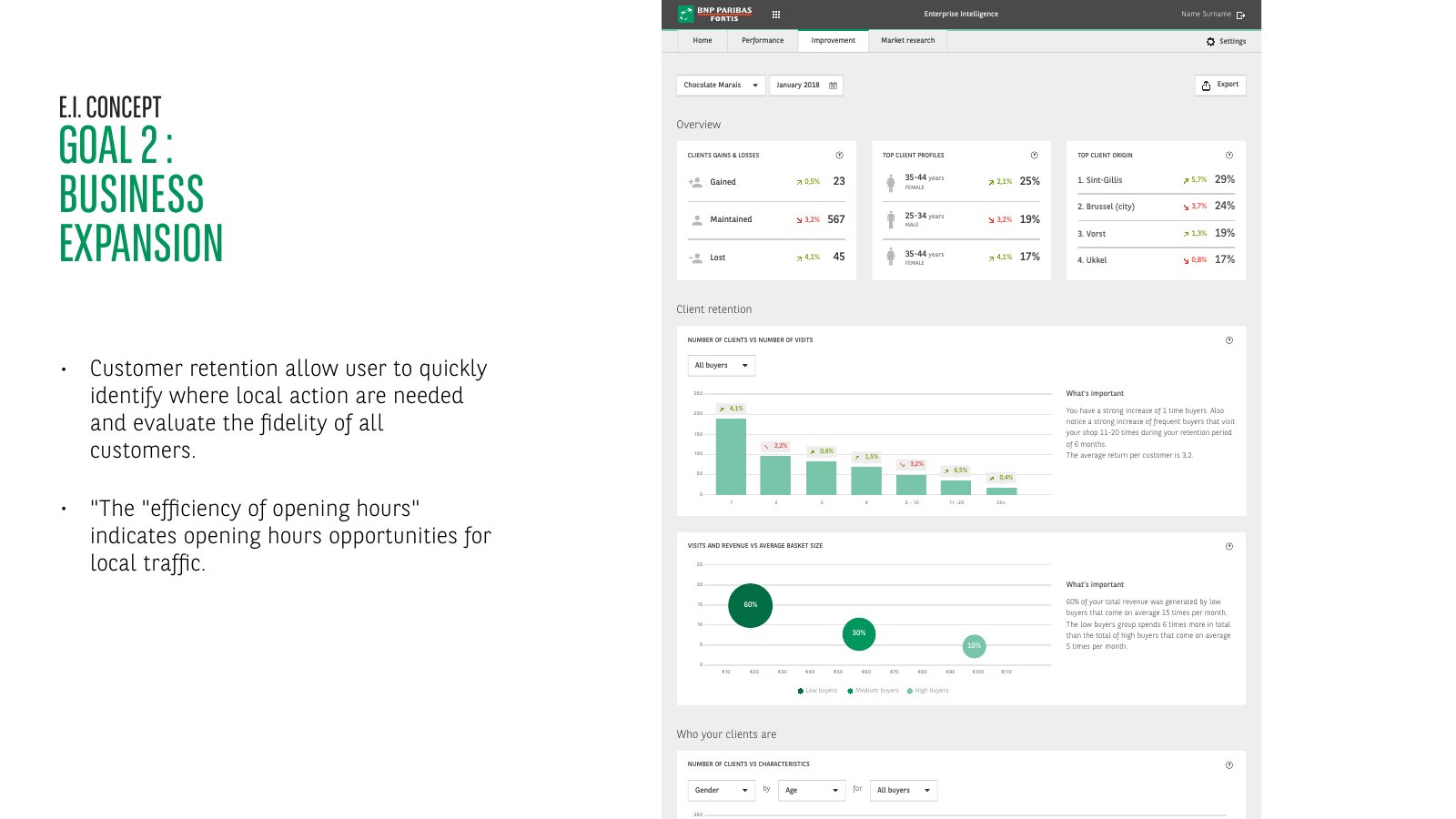
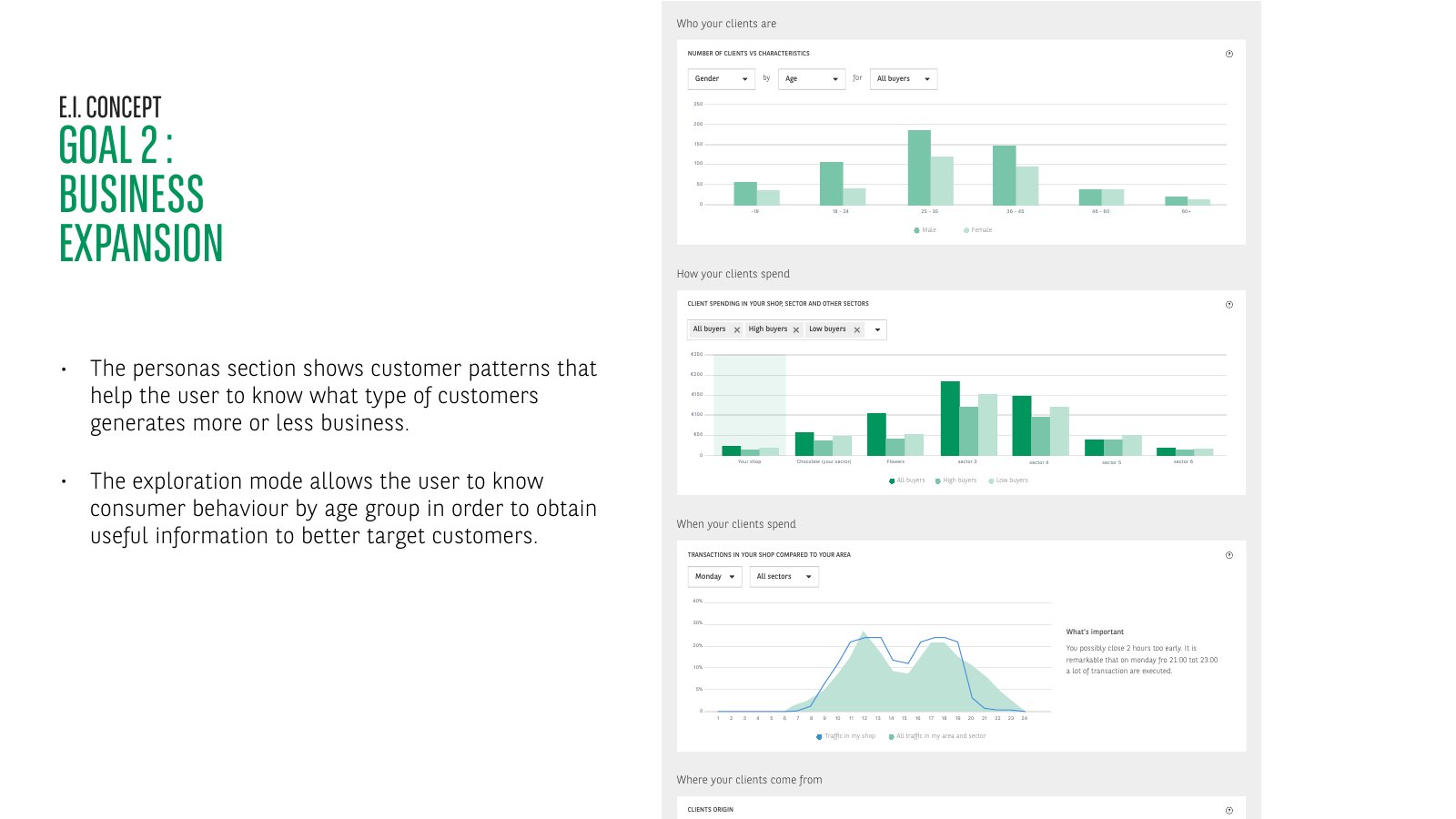
Action mode · five coached reads to decide what to change. Who are my real customers, when do they buy, who returns, who leaves, when do I open. Each feature points to a decision.
The promise : instead of exploring 20 demographic segments, the report shows only the 3 that matter — and tells which one is slipping.
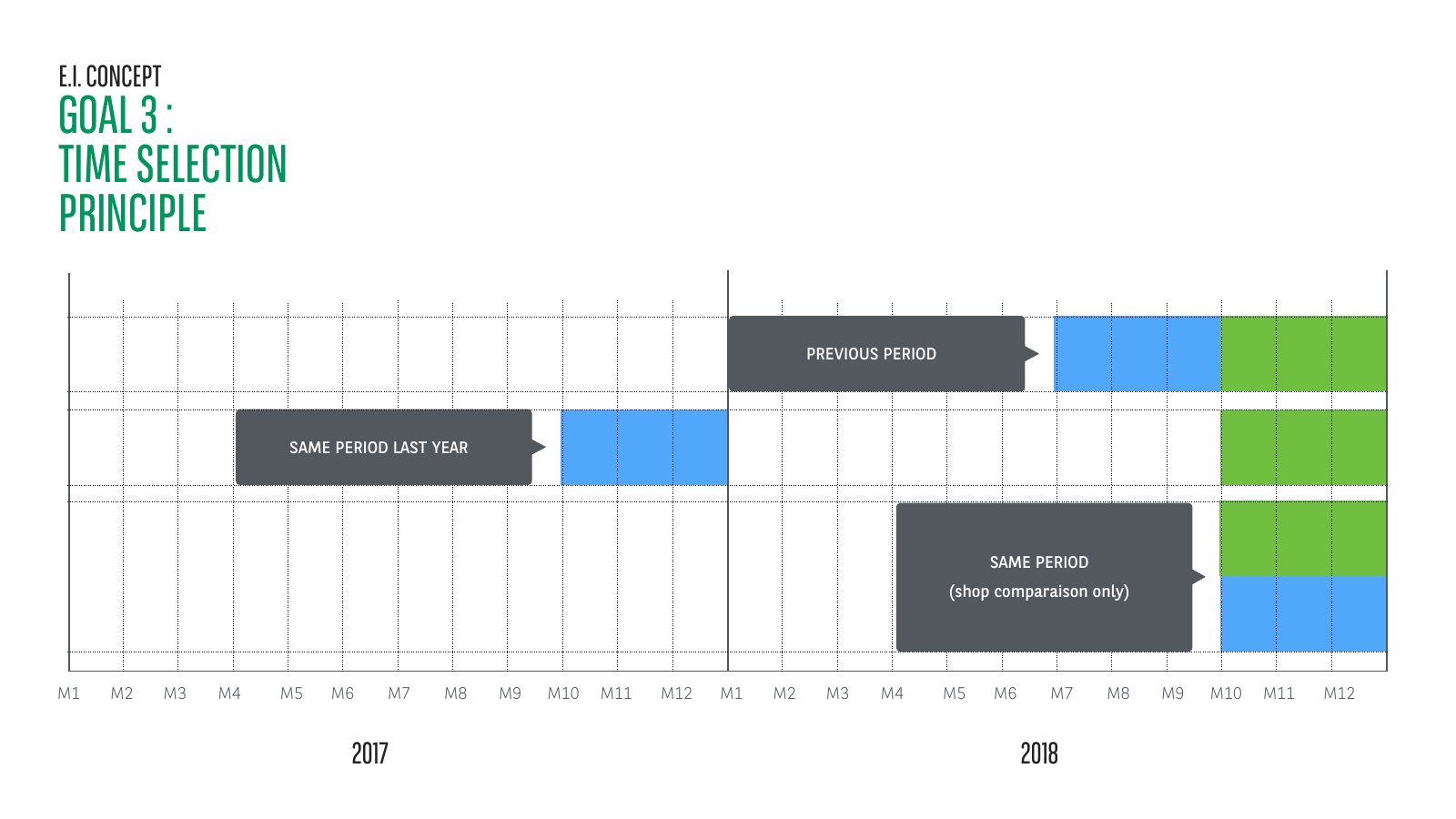
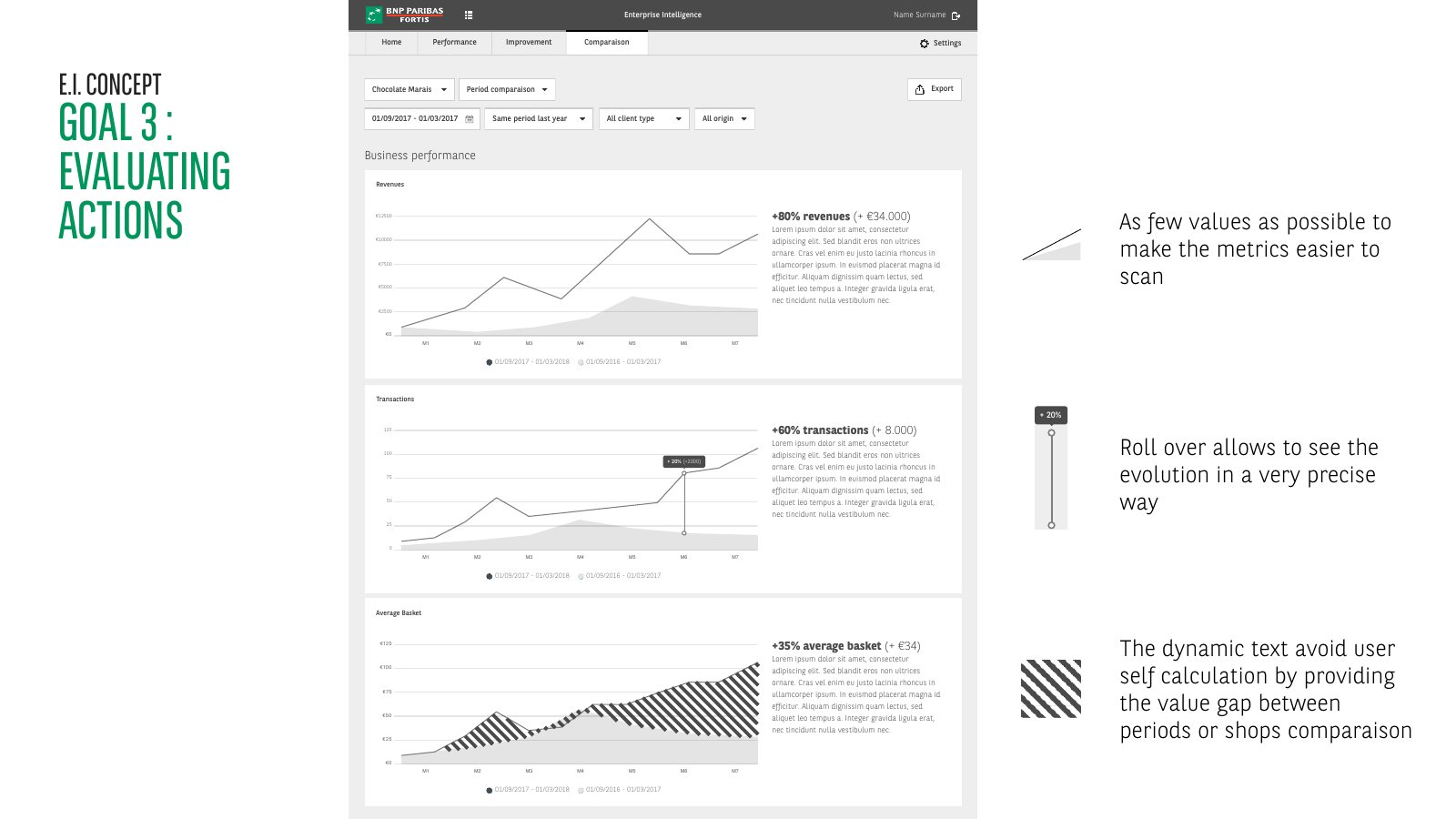
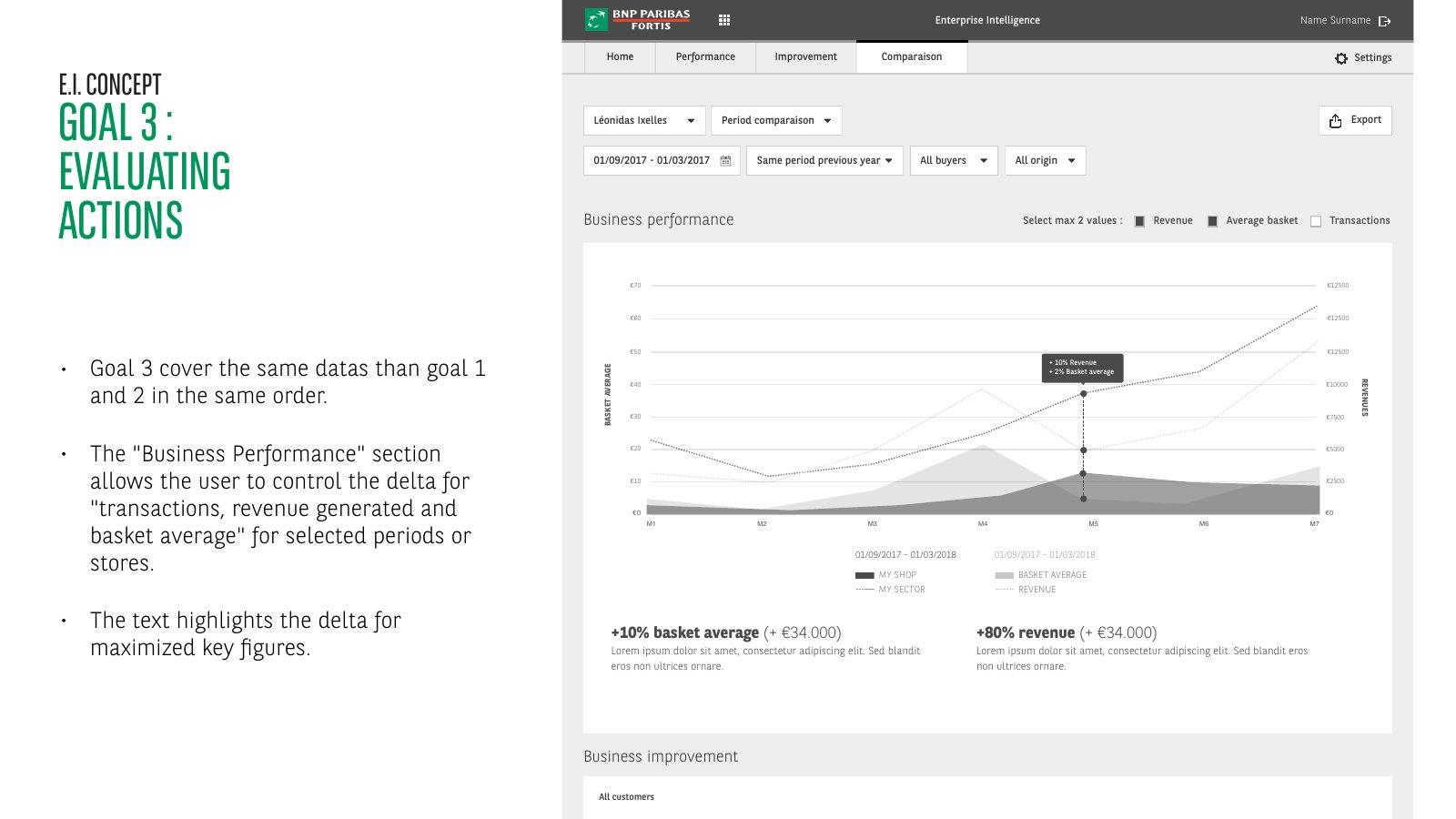
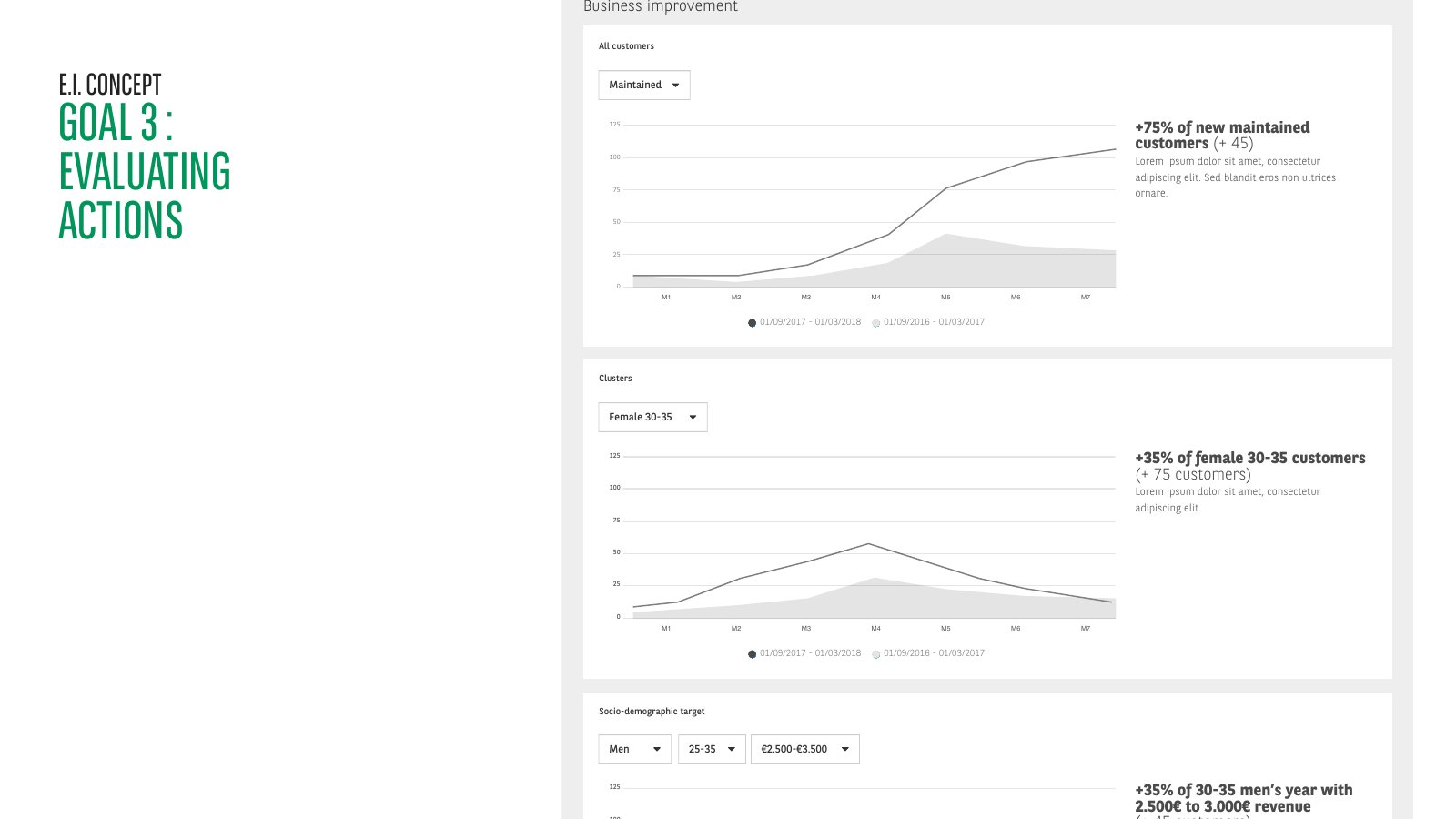
To evaluate an action, you have to compare. Three time windows · same period N-1, previous period, same period current (multi-shops). Co-design with Léonidas on this foundation.
The promise : no mental arithmetic. The delta is computed server-side, shown next to each chart.
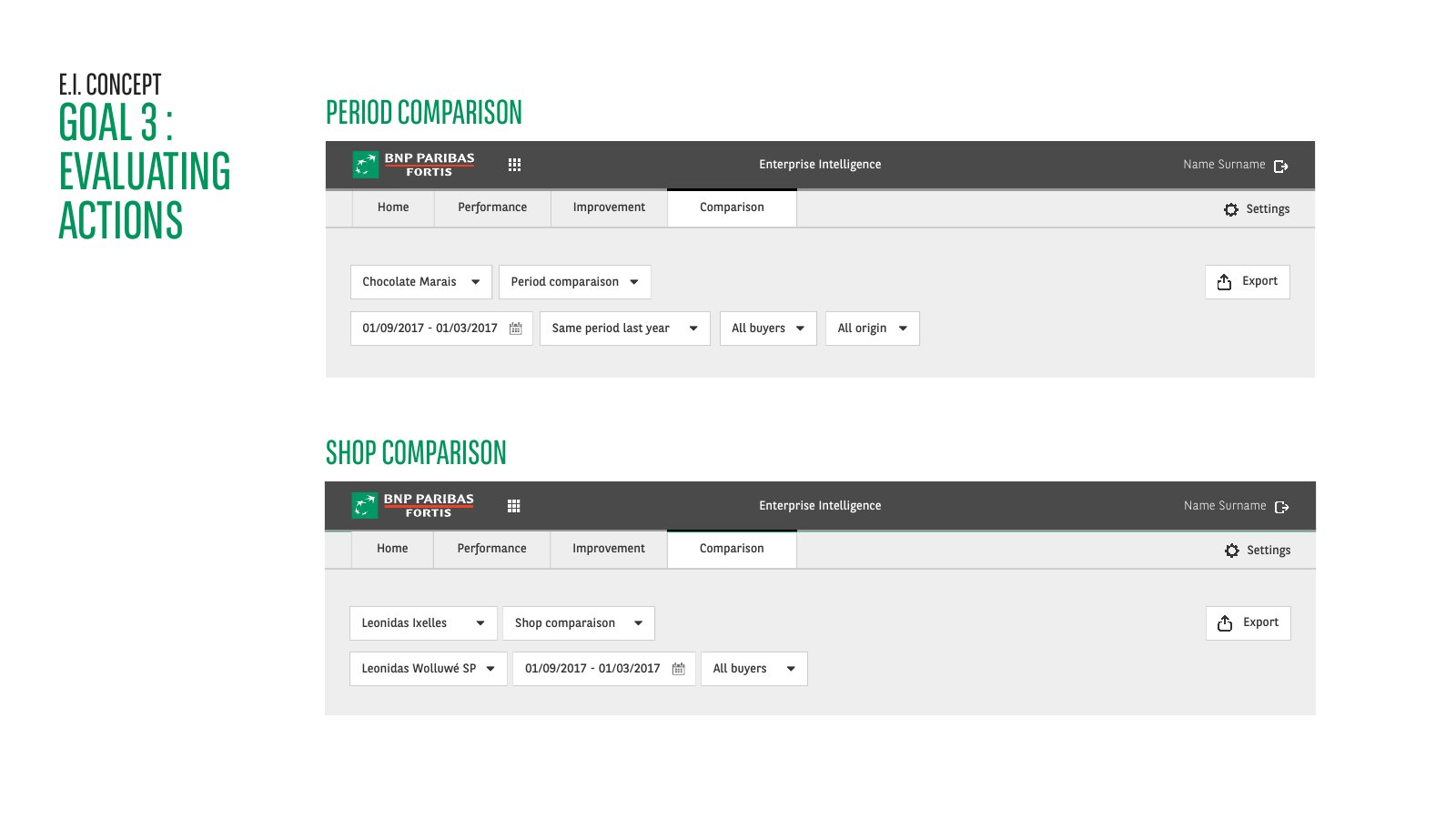
Same shop, two time windows. "January 2018 vs January 2017" on revenue, transactions, average basket. The delta is calculated, not to rebuild.
Two shops in the same group, same period. The merchant puts his two best/least good side-by-side and reads the gap at a glance. No exploration, a frontal read.
Strategic decision · where to open a new shop, in which vertical to extend. Out of MVP scope · the data is there, the service requires another level of sponsor maturity. Phase 2, horizon 2020.
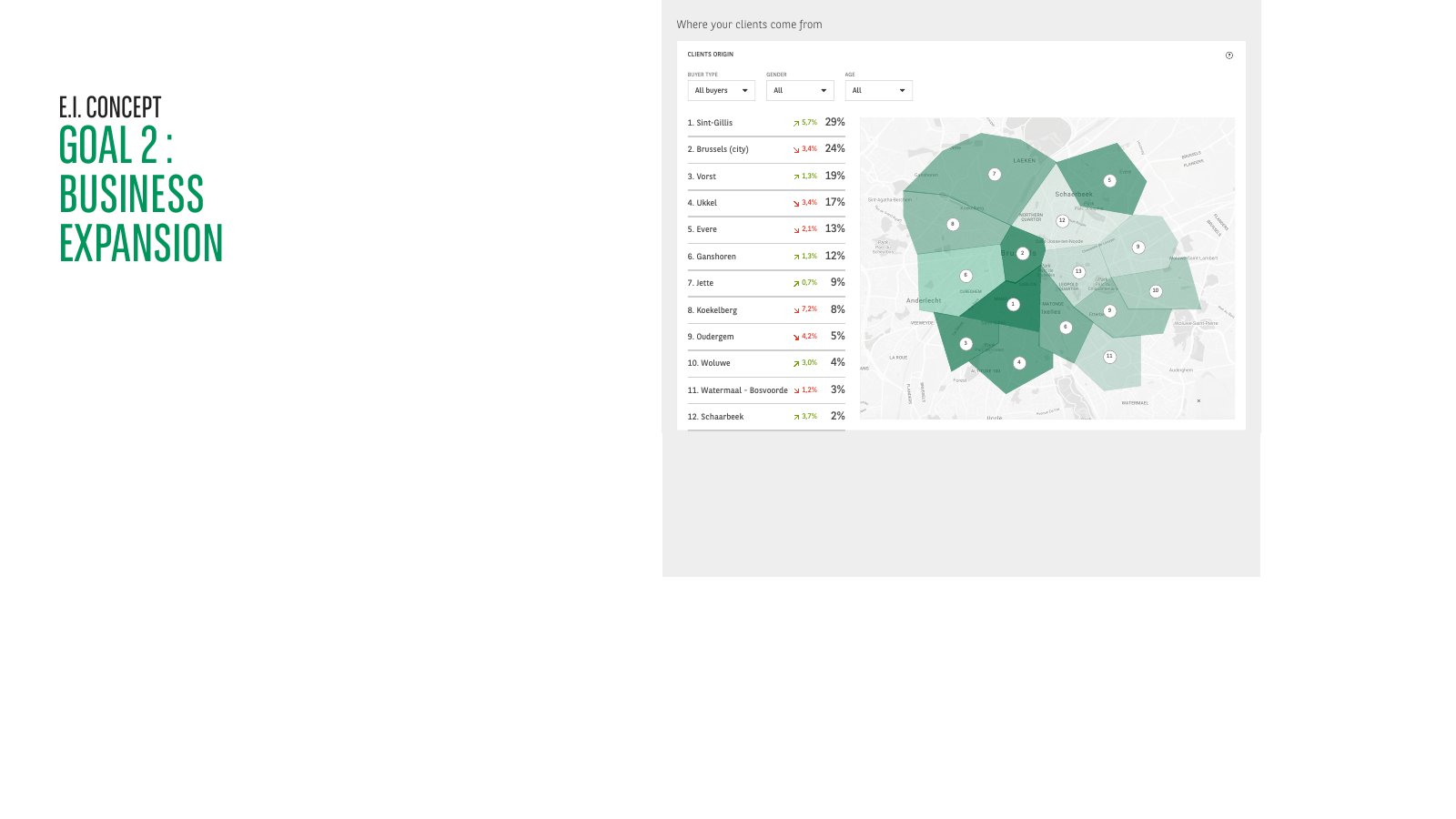
Mapping of zones where transactional data reveals uncovered demand. The merchant picks his next location with evidence, not intuition.
Detection of adjacent verticals where the customer profile buys but the current offer is missing. For chains that want to diversify without guessing.
Six SMEs test the Spotfire prototype unaided. One — the Léonidas group — signs a firm purchase commitment.
The sponsor signed. Six SMEs were tested · one committed, five declined. The go-production decision was made on the written commitment of the Léonidas group, dated before development.
Each function, its own friction. Each conversation, held at its moment.
Friction · a B2B product without a signed customer is unsellable at board level. The Discover phase sourced six SMEs and brought in Léonidas as a signed purchase commitment before any build.
Friction · urge to start coding before the service blueprint. Five end-to-end customer journeys put on the table the figure that closed the debate in week 6 · 15 steps spread over 1-3 days just to onboard.
Friction · reputational risk on card data. The Triple-Win frame set the rule from the value prop onwards · zero individual data exposed, aggregated statistics only, GDPR de-risked before any build.
Friction · appetite for data richness. The six user barriers arbitrated in week 9 · three coached reads per chart, the rest in phase 2.
Marketing and IT at the same workshop table. No defensible Value Proposition unless both carry it.
The service only held if all three vertices won. Two out of three · dropped.
Transactional data already existed, dormant. The service turns it into a payable subscription, defensible, outside the bank's core competition.
The merchant reads a goal-oriented report, acts, measures. No data expertise required. The service fits an SME's day, not an analyst's workflow.
Aggregated statistics only, never a named transaction. GDPR de-risked from the value prop onwards, validated by Legal & Compliance before build.
Any idea that did not validate the three vertices was set aside. Three criteria, not an average.
A firm purchase commitment, signed before the first line of code. Written, dated, on the sponsor's desk.
Four internal functions (Banking · IT · Legal · Marketing) aligned on a locked MVP scope. March 2018.
Léonidas Ixelles and Léonidas Woluwe-SP were already named in the Concept Report wireframes, as the example used for shop-to-shop comparison. The pre-signature turned a name in a mockup into a firm purchase commitment, conditional on go-live.
User stories prioritised P1/P2, MVP scope locked, ready to enter agile sprints on the IT side.
Integrity note. I left BNP after the Concept Report was delivered, to join Belfius. I had no further news of the project.
I bring this case back out whenever a sponsor asks what an upstream project is worth. The answer sits inside the triangle : if the three vertices win, we keep it. Otherwise, we drop it.